DANIEL ROBERT MAZURTHE ARCHITECTURE OF BELIEFShop the books ↗


An inquiry into evidence, influence & belief

The Evidence
Left Outside
the Frame

On Expelled, Intelligent Design, and the stories that shape what we believe.

Before you begin

What changes when we discover
what we were never shown?

A documentary offers more than information. Through its interviews, images, and omissions, it gives us a way of understanding what we see. But how much can we judge when we do not know what has been left out?

This essay examines Expelled: No Intelligence Allowed through that question. It follows the evidence, considers the responsibilities of its filmmakers, and asks what the same standard requires of the person writing about them.

01 / Read

The story beyond
the screen.

A personal examination of persuasion, withheld context, and our responsibility to the people whose understanding we help shape.

From the Dover trial to a filmmaker’s later account, this essay considers what happens when loyalty to a cause becomes more important than an honest examination of it.

Scroll within the essay frame to read the complete text, including linked citations and sources.

Full essay · Sources and endnotes

The Evidence Left Outside the Frame

On Expelled, Intelligent Design, and the Stories That Shape What We Believe

I have spent much of my life trying to understand how people come to believe what they believe. Not simply why one person accepts an explanation while another rejects it, but how those explanations become part of us in the first place. How they influence our judgments, our relationships, our understanding of ourselves, and eventually the choices we make. I have become particularly concerned with the influence of authority, especially when those exercising it possess information that the people relying upon them do not.

My interest in these questions grew from experiences I explored in my memoir, COR Values, and continued examining through fiction in Beyond the Morning Light and my most recent novel, WATCH. Although different in form and subject, these books share a concern that has become increasingly important to me: How much of what we regard as our own understanding of reality has been shaped by circumstances we never knew to question?

That concern is one reason I find the 2008 documentary Expelled: No Intelligence Allowed, starring Ben Stein, so troubling. The film presented Intelligent Design as a scientifically legitimate explanation that had been unfairly excluded by scientists, educators, academic institutions, and others unwilling to consider conclusions that might challenge their convictions. Viewers were encouraged to see its advocates as courageous dissenters confronting an establishment determined to protect evolutionary theory from examination. Scientists and atheists appeared as defenders of an orthodoxy, people whose attachment to their own beliefs prevented them from considering alternatives.

It was a compelling narrative. But what concerns me is not simply whether the film persuaded its audience. It is how that audience was persuaded, what information was withheld, and whether those watching understood the circumstances through which their judgments were being formed.

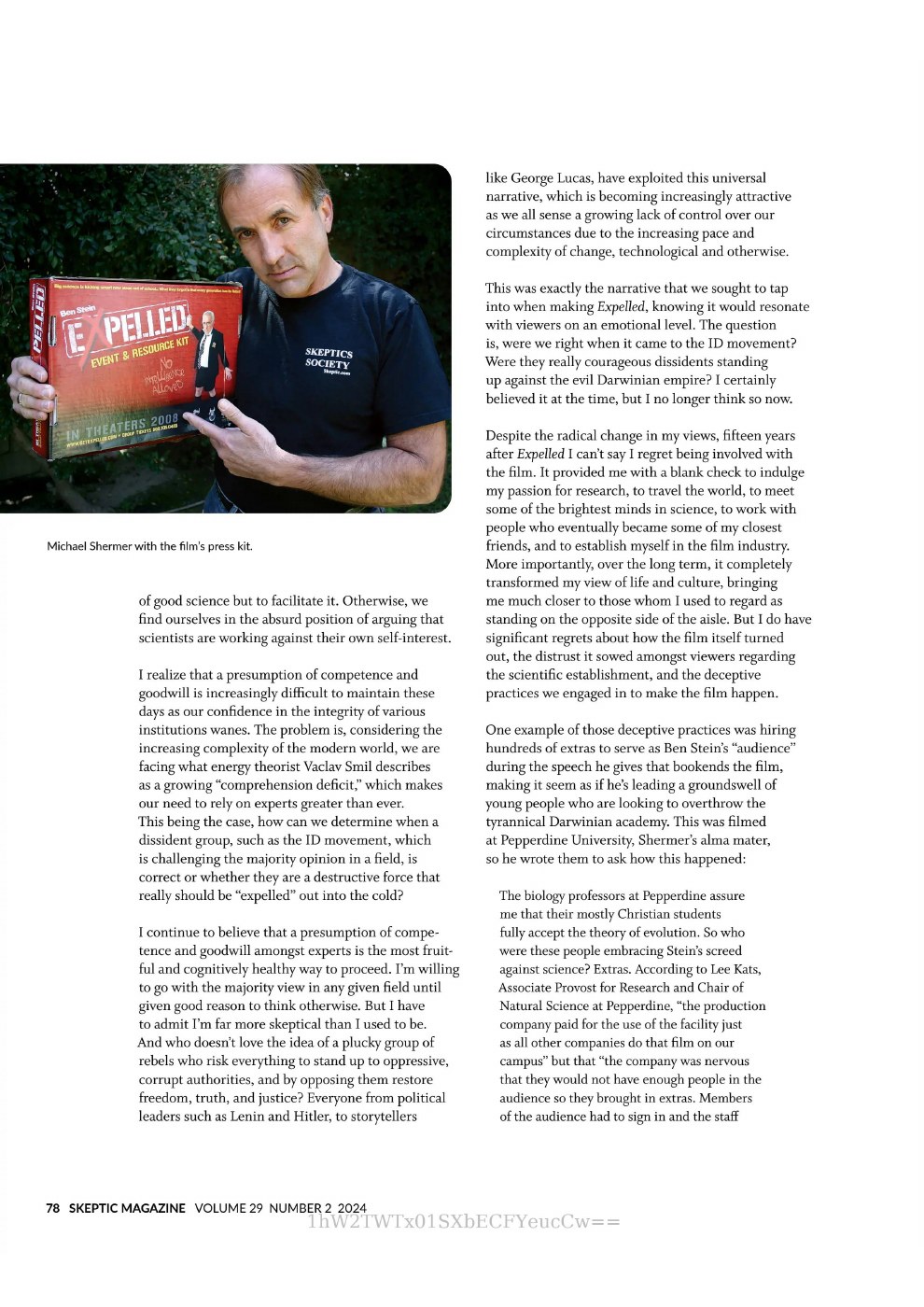
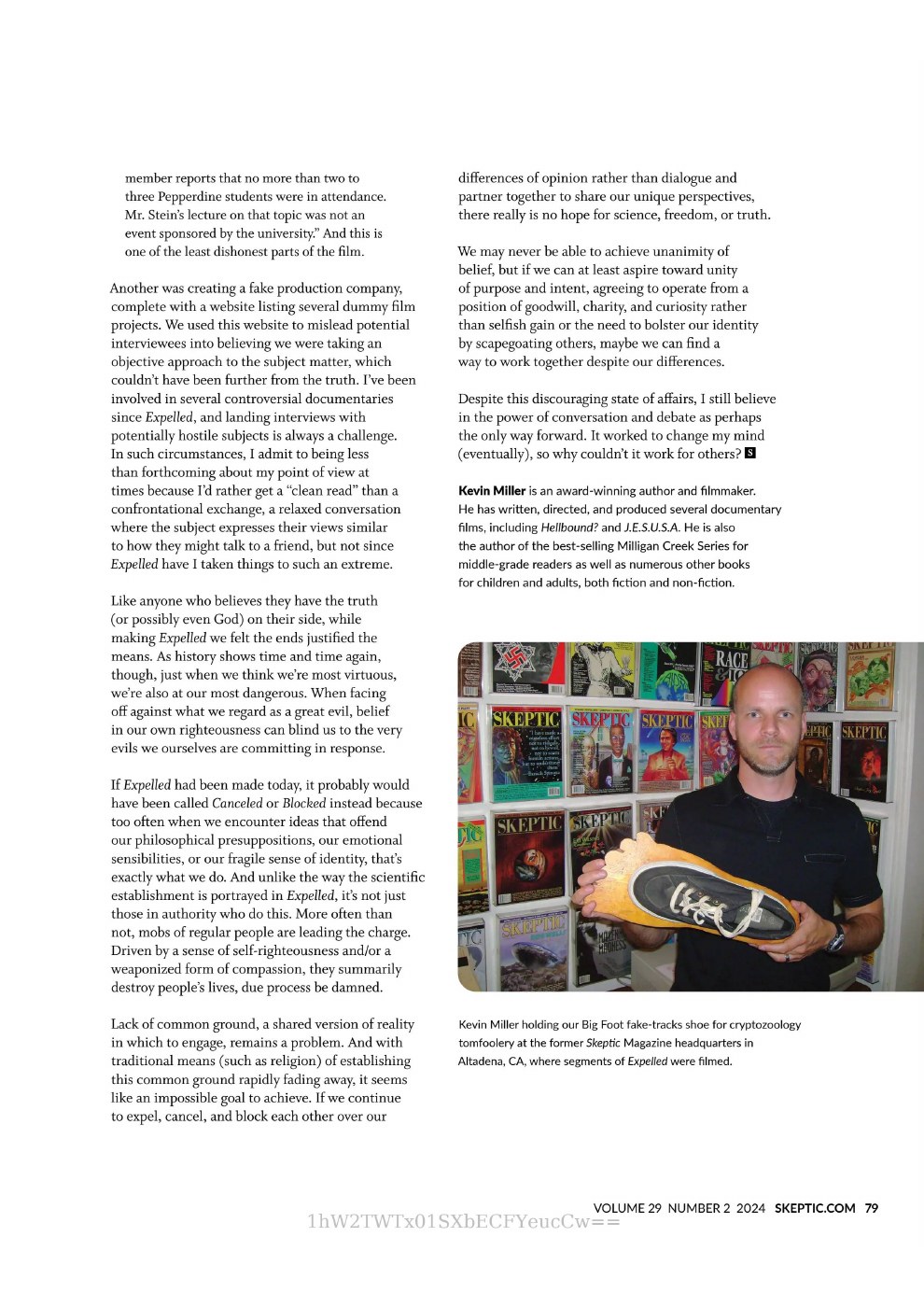
There is a personal connection that makes this examination particularly meaningful to me. Kevin Miller, one of the writers of Expelled, served as the editor of all three of my published books. His involvement in those projects has been valuable, and I appreciate the care and attention he brought to my writing. In 2024, Kevin published an account of his experience making Expelled in Skeptic magazine. He described deceptive practices employed during production, acknowledged his own participation, and explained how his understanding of Intelligent Design changed over time.[1]

His account brought together two subjects I had spent years examining from different directions: the formation of belief through selective presentation, and the responsibility we bear when we recognize that we have influenced others through an incomplete or misleading account of reality.

I do not approach this subject because I wish to discredit Kevin personally. His willingness to examine his earlier involvement gives me reason to appreciate an important part of what he has done since. But appreciation for a person and concern about that person's conduct are not mutually exclusive. One of the questions running through my writing is how people capable of genuine good can also cause harm, sometimes without fully recognizing the forces influencing their decisions. Understanding the good does not require denying the harm, just as recognizing harm does not make everything good a person accomplished imaginary.

A hearing, not a silencing

To understand why Expelled troubles me, it is necessary to return to a federal courtroom in Pennsylvania, three years before the film's release. In 2005, eleven parents challenged a policy adopted by the Dover Area School District directing ninth grade biology students toward Intelligent Design as an alternative to evolutionary theory. The resulting case, Kitzmiller v. Dover Area School District, became one of the most consequential examinations of Intelligent Design in American history. Over six weeks of testimony, scientific experts, educators, historians, philosophers, and Intelligent Design advocates presented arguments concerning the scientific standing of the proposed explanation and the religious purpose alleged to underlie the school's policy.[2]

On December 20, 2005, Judge John E. Jones III issued a 139 page decision concluding that Intelligent Design was not science and that Dover's policy violated the Establishment Clause of the First Amendment. The court examined the movement's arguments concerning irreducible complexity, its reliance on supernatural causation, its objections to evolutionary theory, and its lack of a demonstrated scientific research program capable of establishing the claims made for it. The court also examined the historical relationship between Intelligent Design and creationism, finding substantial evidence that the former developed from the latter.[2]

One fact about this decision deserves particular attention. Judge Jones was himself a Christian, a practicing Lutheran, a Republican, and a federal judge appointed by President George W. Bush. This does not make his ruling correct because of his religious affiliation. Evidence and reasoning, not personal faith, must determine the credibility of a judicial decision. But his background challenges the suggestion that Intelligent Design was rejected because atheists and secular institutions were determined to exclude religious believers. A Christian judge examined the evidence and concluded that Intelligent Design did not qualify as science. He did not need to abandon Christianity to reach that conclusion. Nor was he alone among religious individuals who opposed Intelligent Design's scientific claims. Kenneth Miller, the biologist who testified against Intelligent Design, was a practicing Catholic who had written about the compatibility of religious belief and evolutionary science.[3]

This distinction matters. Science does not require scientists to be atheists. It requires explanations that can be investigated through evidence and scientific methods. A person may believe that a creator exists, that the universe has purpose, or that intelligence ultimately underlies natural reality. Such beliefs do not automatically become scientific explanations, nor does declining to recognize them as such constitute persecution. The Dover court did not rule on whether God exists. It examined whether the particular claims and school policy before it met scientific and constitutional standards.

What the film left outside the frame

I find the distinction between being denied a hearing and failing to persuade after receiving one especially important. Intelligent Design was not excluded from examination at Dover. Its proponents presented witnesses and arguments. Their evidence was considered, and the court explained why it found the claims inadequate. Advocates remained free to disagree with the decision, criticize the reasoning, publish their arguments, and continue seeking scientific acceptance. An unfavorable conclusion does not establish that an inquiry was dishonest. Sometimes it means an inquiry took place and the evidence failed to support the claim.

Yet Expelled presented the controversy through a narrative of exclusion. The documentary discussed legal challenges to Intelligent Design, questioned whether scientific disputes should be addressed through litigation, and portrayed judicial involvement as an impediment to intellectual freedom. The film even presented the accusation that Intelligent Design was an attempt to introduce creationism into science classrooms. But it did not meaningfully examine the documentary evidence supporting that accusation. The available dialogue transcript contains no identification of the Dover trial, no explanation of Judge Jones's findings, and no meaningful account of the evidence considered during those proceedings.[4]

This omission is consequential because the trial directly challenged the film's central portrayal. The audience was encouraged to view judicial resistance as evidence that Intelligent Design had been denied fair consideration, while receiving no adequate account of the most significant hearing in which its claims had been examined. The filmmakers could have presented the ruling and disagreed with it. They could have interviewed witnesses from both sides, challenged the judge's interpretation, and allowed viewers to evaluate the competing arguments. Instead, the film supplied a narrative of unfair treatment without the historical context most relevant to evaluating that accusation.

Nor was the information difficult to obtain. The trial and decision were matters of public record. In November 2007, before Expelled reached theaters, PBS broadcast Judgment Day: Intelligent Design on Trial, a detailed documentary examining the proceedings and evidence. The record existed. Its absence from Expelled was not the consequence of information becoming available only after the film was completed.[5]

How stories shape belief

This raises a question that has occupied much of my writing. What happens when people are given enough information to reach a conclusion, but not enough to recognize why that conclusion may be mistaken? The information they receive need not be entirely false. It may contain accurate statements, genuine testimony, and events that actually occurred. Yet if material facts are omitted, or if those facts are arranged to support a preferred interpretation, the resulting understanding can be profoundly misleading.

In The Choices We Inherit, an essay explaining the ideas behind WATCH, I wrote that a story does not have to be false to be deceptive. Sometimes it need only leave out the truths that would change its meaning. That concern emerged partly from my own experience of being understood by others through accounts of my life that were not entirely imaginary, but were incomplete in ways that mattered.

The architecture of belief

I grew up within a religious environment in which my father was also my pastor. His particular interpretations of religious belief influenced how our family and religious community understood authority, loyalty, obedience, and separation. These beliefs did not remain abstract theological propositions. They affected relationships. They influenced whose questions were acceptable, which disagreements could be tolerated, and when withdrawing from another person could be regarded as necessary or even righteous.

As a child, I was not examining these beliefs from a position of independence. They were part of the world through which I learned about family, morality, belonging, and my own place among others. Their authority came not only from what I was taught, but from the people I loved, the relationships I depended upon, and the consequences associated with questioning what was accepted.

Over time, family division and estrangement contributed to a period of profound personal crisis that eventually resulted in my involuntary commitment to a psychiatric hospital. My psychological deterioration was real. I do not deny that, nor do I regard it as the consequence of one event or one person's actions. But within the religious community from which I had become separated, my crisis could be understood as evidence of what happened when someone questioned established authority or departed from the beliefs that sustained the community.

That interpretation did not require anyone to invent the hospitalization. It happened. What could be missing were the years of family conflict, rejection, isolation, conflicting explanations, and increasingly desperate attempts to understand experiences I could no longer reconcile. Those who knew the outcome did not necessarily know the circumstances that contributed to it. The event could therefore appear to confirm an existing belief, even though a fuller understanding might have complicated that conclusion.

This experience contributed to what I now think of as the architecture of belief: the relationships, expectations, fears, rewards, loyalties, and explanations through which ideas come to feel self-evident. People may sincerely believe they have reached a conclusion independently while remaining unaware of how much of the information shaping that conclusion was supplied or withheld by others.

My concern is not that people should be protected from uncomfortable conclusions. It is that they should have the opportunity to examine the evidence necessary to reach their own.

How Intelligent Design was framed

The history of Intelligent Design offers a particularly revealing example of how the presentation of an explanation can influence its acceptance. In 1987, the United States Supreme Court ruled in Edwards v. Aguillard that a Louisiana law requiring creation science instruction whenever evolution was taught violated the First Amendment because its purpose was to advance a particular religious belief.[6] In the development of the textbook Of Pandas and People, later recommended to Dover students, references to creationism and creationists were systematically replaced with Intelligent Design terminology. The Dover court examined successive manuscript drafts, documenting approximately 150 substitutions and finding that the underlying explanation remained substantially unchanged.[2]

One transitional manuscript contained the peculiar expression cdesign proponentsists, apparently produced when the replacement of creationists with design proponents was incomplete. The editorial error provided a visible trace of the transformation in language. The court concluded that Intelligent Design was a successor to creationism rather than an independent scientific explanation emerging from new research.

The significance of this history is not that religious individuals were interested in science. Many religious people have made important scientific contributions, and personal convictions can inspire legitimate questions. The concern is whether a religious proposition was being presented as scientifically independent of its origins without the evidence necessary to justify that claim. Replacing religious terminology with scientific language does not automatically transform a religious explanation into a scientific one.

The Discovery Institute's own history adds to this concern. Its 1998 Wedge Document outlined a strategy for challenging scientific materialism and promoting a theistic understanding of nature. The goals extended beyond scientific investigation to cultural influence, public education, media activity, and the advancement of design arguments.[7] The Institute has defended those objectives, maintaining that Intelligent Design is a scientific proposition rather than a religious doctrine. It also opposed the Dover school board's mandatory policy, while advocating greater consideration of criticisms of evolutionary theory in science education.[8]

That distinction matters. We cannot responsibly assign the conduct of the Dover board to every individual or organization supporting Intelligent Design. But neither can the movement's documented religious objectives, the rewriting of Of Pandas and People, and the court's findings be ignored when evaluating claims that Intelligent Design developed independently of efforts to introduce religious explanations into public school science instruction.

The distinction between a movement's stated purpose and its demonstrated purpose was central to the Dover decision. The school board described its policy as encouraging critical thinking and improving science education. Yet the court found that the board's claimed secular purpose was a pretext for advancing religion. That conclusion arose from testimony, documents, and the conduct of those responsible for the policy, not simply from their religious affiliations.[2]

Here again, the language through which an idea is presented matters. A proposal described as encouraging critical thinking may sound reasonable. But if its purpose is to introduce a religious explanation as scientific knowledge, the reassuring description can conceal information essential to evaluating the proposal honestly.

The story-making behind WATCH

This is where I see a particularly important connection to WATCH. The novel follows a young man whose life becomes increasingly influenced by an organization known as the Order. Its philosophy, expressed through The Creed of the One Story, speaks of unity, responsibility, trust, and preserving a common understanding. These values are not inherently objectionable. Communities need trust. People need belonging. Shared explanations can help individuals live together. But the Creed gradually reveals a troubling priority. Preserving the accepted story becomes more important than examining whether the story remains true.

The Order does not require everyone within it to understand that information is being manipulated. In some respects, its authority depends upon people not knowing. Those who act within it may sincerely believe they are protecting others. They may provide genuine assistance, establish meaningful relationships, and accomplish considerable good. The danger emerges when possessing information is treated as permission to determine what others may know and when they may know it.

I did not write WATCH to suggest that every person exercising authority is knowingly deceptive or that every relationship influenced by someone else's intentions is artificial. I wanted to examine how genuine care can coexist with harmful decisions, how people inherit explanations they never fully question, and how easily the desire to protect others can become permission to choose for them.

What the production account reveals

Kevin Miller's account of Expelled illustrates some of these difficulties in a real production that publicly defended intellectual freedom. Kevin explains that he initially agreed with the film's agenda. During the two and a half years he worked on it, however, his understanding changed. He encountered arguments from both sides, questioned aspects of the Intelligent Design movement, and became increasingly uncomfortable with the producers' intentions. He remained involved, hoping to provide some balance, but recognized that those financing the film ultimately controlled its point of view.[1]

The documentary was not produced by the Discovery Institute, and its production company should not be confused with the organization advocating Intelligent Design. Yet prominent Discovery Institute figures appeared in the film, and the Institute publicly promoted its release. The connection was therefore more than an abstract similarity of beliefs. The film gave substantial attention to advocates with an institutional interest in gaining greater recognition for Intelligent Design, while withholding important evidence challenging that movement's claims and history.[4][9]

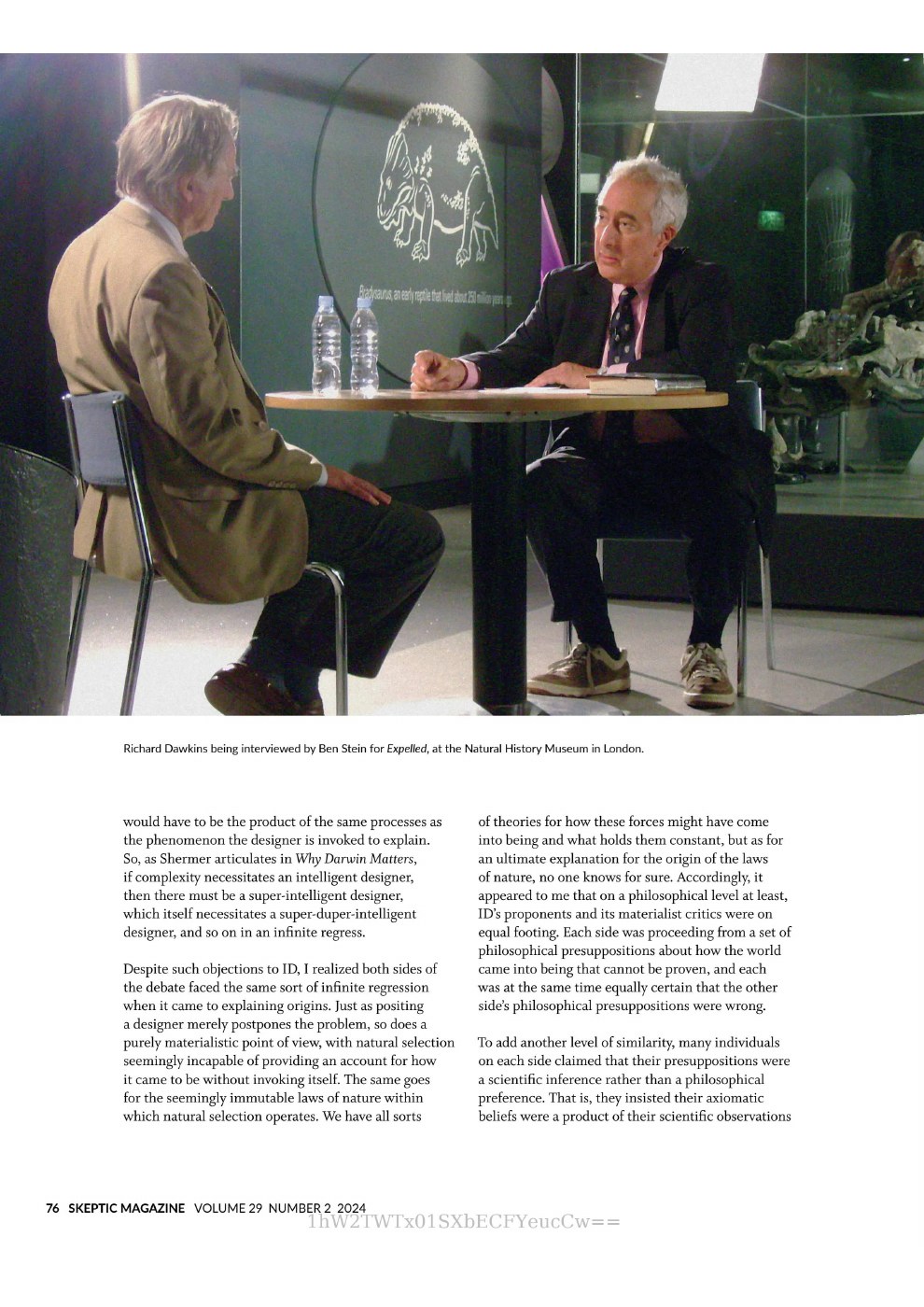
Kevin's account also confirms that misleading practices were used to obtain interviews. Richard Dawkins, Eugenie Scott, P. Z. Myers, Michael Shermer, and others said they had agreed to participate in a project called Crossroads, described as an examination of the relationship between science and religion. That was not the film they ultimately appeared in. Kevin later acknowledged that the production created a misleading company identity, including a website featuring fictional film projects, to encourage prospective interviewees to believe they were participating in a more objective investigation than the filmmakers intended.[1]

The ethical problem begins before any interview is edited. A person who believes he is participating in an open discussion may respond differently from someone who knows the interviewer intends to construct an argument against him. He may explore hypothetical possibilities, acknowledge uncertainty, or offer qualified answers without anticipating that those qualifications may later be used to suggest intellectual weakness.

Michael Shermer described how an exchange concerning the alleged dismissal of Intelligent Design advocates was presented within the film's narrative of persecution. Shermer had questioned the premise and asked for specific examples, explaining that he knew of no demonstrated instance fitting the accusation. In the finished film, however, his responses were placed among stories intended to persuade viewers that systematic mistreatment was occurring. The distinction is consequential. Questioning whether an accusation has been established is not equivalent to accepting the accusation while admitting ignorance of its examples.[9]

Richard Dawkins's interview illustrates another problem. Asked to consider whether life might have originated through intelligent intervention, Dawkins entertained a hypothetical possibility involving an advanced extraterrestrial civilization. He was not claiming that such an event had occurred or that a supernatural creator had been demonstrated. He was considering a conceivable explanation that, if supported by evidence, could be examined scientifically. The film used the exchange to suggest that Dawkins might accept intelligent design, provided the designer was not God. The distinction between considering a possibility and endorsing it was blurred in a way that encouraged the audience toward a conclusion not established by his answer.[4]

These examples matter because the willingness to consider possibilities is part of scientific inquiry. Scientists routinely investigate explanations they do not believe are established. They acknowledge uncertainty, examine alternatives, and distinguish what evidence demonstrates from what remains unknown. Such practices do not reveal weakness in scientific reasoning. They are among its strengths. When a documentary uses these qualities to suggest that an interviewee has been caught in a contradiction, intellectual openness becomes material for discrediting the person who displayed it.

Kevin's article describes another revealing production decision. Hundreds of extras were hired to form an audience for Stein's speech at Pepperdine University. The sequence created the appearance of enthusiastic public support for the film's message. There is nothing inherently objectionable about using extras in a staged production. But when a documentary presents an audience without explaining that the gathering was constructed, its reaction can become an argument of its own. Applause suggests agreement. A crowded auditorium suggests momentum. Viewers may infer that they are witnessing genuine public enthusiasm without knowing how that impression was created.[1][9]

The irony is difficult to overlook. A film accusing scientific institutions of manufacturing consensus used a constructed audience to reinforce its own message.

The documentary also employed emotionally powerful associations between evolutionary theory, Nazism, and the Holocaust. The historical misuse of scientific ideas is a legitimate subject for investigation, but demonstrating that a political movement invoked an idea does not establish that the idea caused its crimes or that the underlying scientific explanation is false. Evolutionary biology describes biological processes. It does not prescribe a moral system or establish that some people possess greater human worth than others. Kevin recounts that members of the production team were uneasy about this direction, recognizing the difficulty of holding evolutionary theory responsible for its misuse while ignoring similar abuses involving religious or political ideas.[1]

How presentation shapes meaning

What connects these practices is not necessarily the invention of facts. An interviewee may have spoken the words shown on screen. A scientist may have expressed uncertainty. A legal dispute may have occurred. An audience may have occupied an auditorium. Yet the meaning viewers assign to these events depends upon circumstances they may not have been told.

That is the connection to WATCH that matters most to me. The central injury is not always the removal of a person's ability to choose. Sometimes it is the concealment of the circumstances necessary for a more informed choice.

But the novel raises another question that I believe must also apply to this essay. What happens when someone who has experienced manipulation begins using comparable methods because he believes his purpose is justified? In WATCH, the protagonist eventually faces the uncomfortable recognition that his own desire to protect others and expose wrongdoing can lead him to withhold information they have a right to know. The intention may be honorable, but it does not automatically make the conduct right.

This was essential to the novel because I did not want the discovery of wrongdoing to become an excuse for repeating it. The ability to recognize manipulation when we are its victims does not guarantee that we will recognize it when our own convictions make manipulation seem necessary.

Kevin reaches a related recognition in his account of Expelled. He reflects on how those making the film believed their cause justified the methods used to advance it. For me, this may be the most important part of his article. The problem is not simply that deceptive practices occurred. It is that people who believed they were defending intellectual freedom could come to accept methods that compromised the very freedom they claimed to protect.

When an account comes later

This makes the timing of Kevin's account worth considering. The film reached audiences in 2008. His detailed public reflection appeared in Skeptic in 2024, roughly sixteen years later. Why did so much time pass before that acknowledgment appeared?

I do not know the complete answer, and I would not pretend to. Kevin describes a continuing change in his views, a later apology to Shermer, and the invitation that led to publication. He also acknowledges the professional opportunities the film provided. It is reasonable to wonder whether professional relationships, loyalty, the gradual development of his understanding, or reluctance to revisit an earlier decision influenced the timing. But those remain possibilities, not established explanations.

What concerns me more than the precise reason for the delay is its consequence. The documentary reached its audience years before Kevin's detailed account of its production became available. Some viewers may have developed lasting impressions of the scientists interviewed, the legitimacy of Intelligent Design, or the alleged hostility of scientific institutions. They may never encounter the later acknowledgment. A correction can become part of the public record without becoming part of the understanding of those influenced by the original message.

This does not diminish the value of Kevin's decision to speak. His willingness to acknowledge his involvement deserves recognition. Revising an earlier conviction and publicly acknowledging one's participation in a troubling enterprise can require considerable intellectual honesty. But sincerity does not eliminate responsibility, and acknowledgment cannot erase consequence. An apology can be genuine and overdue. A person can change and remain accountable for choices made before that change. Both propositions can be true.

Holding good and harm together

I have had to consider a comparable distinction in my understanding of my father. Over time, I became dissatisfied with explanations that treated him as either entirely good or entirely harmful. I had witnessed genuine generosity, dedication, and care for others. I had also experienced the consequences of beliefs and decisions that damaged relationships and contributed to family separation. To accept one account while excluding the other would have required me to disregard part of what I knew.

During the final period of his life, I spoke with him about a food pantry he had helped establish. I was proud of what he had accomplished. People had been fed. Families had benefited. Those were real achievements. But I also wanted him to consider the costs borne by people affected by decisions made within the religious world he had helped create. The good accomplished did not erase those costs, just as the harm did not make the good imaginary.

That experience helped shape the character of Salvatore in WATCH. Salvatore provides genuine assistance, establishes meaningful relationships, and influences lives in ways that are not entirely harmful. Yet he also exercises authority through decisions that affect people who do not always possess the information necessary to understand what is being decided for them. To portray him as entirely malicious would have made his character easier to condemn, but less revealing. I wanted to examine how a person capable of real care could also become capable of denying others the freedom to make informed choices.

The more difficult part of that inquiry was recognizing how comparable tendencies could exist within me. I could not examine the forces that shaped my father without asking what I had inherited from him. Nor could I condemn the manipulation of others without considering whether my own desire to protect people or pursue a worthwhile objective might lead me to withhold information they had a right to know.

That is why I resist an easy conclusion that would divide the people involved in Expelled into villains and victims, believers and atheists, honest scientists and dishonest religious advocates. Such categories may identify meaningful differences in conduct or evidence, but they can also bring an inquiry to an end before we have understood the people involved. Some Intelligent Design advocates may sincerely believe their scientific claims deserve greater consideration. Some scientists may respond to those claims with unnecessary contempt. Some filmmakers may convince themselves that presenting a misleading argument is justified by the importance of exposing what they regard as a greater wrong. None of those possibilities removes the obligation to evaluate evidence honestly.

Nor does treating people with respect require pretending that competing claims possess equal scientific support. Intelligent Design proponents are entitled to present their arguments. They are not entitled to have those arguments accepted as science merely because they are sincerely held or because rejection is uncomfortable. Scientific inquiry must remain open to correction, but openness does not require abandoning the standards through which claims are examined.

Evidence, purpose, and fair judgment

The Dover trial demonstrates that distinction. Its outcome was not a declaration that religious believers should remain silent. It was a judgment reached after extensive testimony, accompanied by an examination of the scientific evidence offered for a proposed explanation. The Christian faith of the judge and of witnesses opposing Intelligent Design further complicates the film's suggested division between religious believers and secular opponents.

The history of Of Pandas and People demonstrates why an explanation's origins and purposes matter when someone seeks to introduce it into a public school science classroom. The Wedge Document establishes cultural and religious objectives that viewers of Expelled would reasonably have needed to understand when evaluating claims about the movement's independence from religion. And Kevin's account of the film's production provides evidence that the documentary itself did not consistently practice the intellectual honesty it demanded from others.

These findings do not require assuming that every Intelligent Design advocate was knowingly deceptive or that every participant in the documentary shared identical intentions. They depend upon evidence that can be examined. The filmmakers could have included that evidence and argued against its significance. Instead, their audience received a presentation in which much of the context necessary to evaluate the claims of persecution was missing.

What we inherit—and what we pass on

I find this important because the danger is not confined to documentary filmmaking, religious movements, or scientific controversies. We encounter the same problem whenever an institution, family, political movement, religious community, or individual becomes more committed to preserving an accepted account of reality than to examining whether that account remains true. Information that challenges the prevailing explanation may be withheld, minimized, or interpreted through language that makes it appear less threatening. Those receiving the explanation may sincerely believe they have reached a conclusion independently, never recognizing the limits imposed upon the information available to them.

In WATCH, the Order does not survive merely because powerful people issue commands. It survives because belonging, loyalty, security, and shared understanding make its authority meaningful to those who accept it. People remain not simply because they are afraid to leave, but because much of what they value is connected to the world they would be questioning. The structure provides genuine benefits, and those benefits can make its underlying assumptions more difficult to examine.

That complexity matters in real life. People may defend beliefs not only because they think those beliefs are true, but because they are connected to people they love, communities they trust, and explanations that have helped them understand their experiences. When challenged, they may feel that more is at risk than the accuracy of a proposition. Their sense of belonging and identity may also be threatened.

I recognize these difficulties from my own past. I also recognize that my understanding of that past has changed as I have learned more. I do not regard every conclusion I reached during my earlier years as necessarily correct simply because it arose from genuine suffering. One of the most important parts of my recovery was learning to distinguish what I could establish from what I feared, inferred, or imagined. I needed to examine my own explanations with the same care I wished others had given to theirs.

The writer's responsibility

That obligation remains important to me in writing this essay. If I criticize Expelled for presenting speculation as evidence, I must not present my speculation about Kevin's motives as established fact. If I criticize the filmmakers for withholding context, I must acknowledge the arguments and distinctions that complicate my own position. If I object to people being mischaracterized through selective presentation, I must take care not to mischaracterize those whose conduct I am examining.

The ethical question applies to the author as much as to the subject.

Kevin's work as the editor of my three books adds a dimension I would not have anticipated when I began examining Expelled. He helped refine writing concerned with belief, authority, withheld information, and the difficulty of recognizing when our own intentions lead us to repeat conduct we condemn in others. I cannot say precisely how he understood every aspect of that work or how he connects it to his experience with the documentary. Those are questions only he can answer.

But I find the relationship meaningful because it reminds me that people cannot always be understood through a single period of their lives or one consequential decision. Kevin participated in a film whose methods he later came to question. He subsequently wrote about those methods, apologized to someone affected by them, and helped edit books examining related moral questions. I can appreciate what he contributed to my writing while continuing to question his earlier participation. I can recognize the value of his public acknowledgment while wondering whether it might have come sooner. Neither position requires the other to disappear.

Perhaps that is part of what it means to take truth seriously. We must be willing to let new information complicate our judgments, including our judgments of people we respect and people whose actions have harmed us.

I did not write WATCH to persuade readers that all authority is corrupt, that every act of kindness conceals an ulterior motive, or that discovering an influence makes every choice unreal. I wanted to explore how our lives are shaped before we understand the forces shaping them, and what responsibilities emerge once we begin to recognize those forces. The novel does not offer the comfort of a complete explanation. Discovering how we were influenced does not erase those influences or determine every choice that follows.

What becomes possible is a more informed examination of what we have inherited, what we are willing to accept, and what we may choose not to pass along.

That is also what I hope this examination of Expelled can encourage. My purpose is not to persuade religious believers to abandon their faith, nor to suggest that atheists and scientists are beyond criticism. It is to ask whether we are willing to examine how our convictions were formed, what evidence we have been given, what evidence may have been withheld, and whether the explanations we continue defending deserve the confidence we place in them.

What an audience deserves

The documentary's deepest failure was not that its makers supported Intelligent Design or challenged evolutionary science. They were free to do both. Its failure was more fundamental. A film demanding intellectual honesty from others did not consistently practice that honesty itself. It presented a controversy over evidence while withholding essential context, used misleading practices to obtain interviews, and constructed impressions that encouraged viewers toward conclusions the available record did not justify.

That failure matters because the audience's judgments were real. Viewers were free to believe the story they were shown. Yet many did not know how carefully parts of that story had been arranged or what lay beyond the frame.

In The Choices We Inherit, I described the central idea behind WATCH in these words: We choose, but we do not choose everything that teaches us how to choose.

That recognition does not make our choices meaningless. It makes our responsibility to examine them more important.

The question is not whether we can free ourselves from every influence that shaped us. We cannot. Nor can we expect to possess every fact relevant to every judgment. But we can become more attentive to what has been omitted, more willing to question what feels self-evident, and more careful about the information we withhold from others.

I cannot determine what someone reading this essay will ultimately believe about Intelligent Design, the Dover trial, Kevin Miller, or Expelled. Nor should I want to. What I can do is present the evidence that influenced my own conclusions, acknowledge where that evidence has limits, and give readers an opportunity to examine it for themselves.

That is the responsibility I believe the filmmakers owed their audience.

And it is the responsibility I owe mine.

Sources and Endnotes

  1. 1. Kevin Miller, “Expelled! The True Story Behind Ben Stein's Anti-Evolution/Pro-Intelligent Design Film,” Skeptic, Volume 29, Number 2 (2024), pp. 72–79. Primary source for Miller's participation, changes in perspective, misleading interview recruitment, staged audience, and later reflections.
  2. 2. Kitzmiller v. Dover Area School District, 400 F. Supp. 2d 707 (M.D. Pa. 2005), December 20, 2005. The federal court's published opinion, including its examination of Intelligent Design, the manuscript history of Of Pandas and People, and its findings concerning the Dover school board's purpose. View the published Dover decision ↗
  3. 3. National Center for Science Education, “Judge Jones Interviewed by The Lutheran” (2006), and contemporaneous reporting of Jones's religious affiliation; Kenneth Miller's testimony in Kitzmiller.
  4. 4. Expelled: No Intelligence Allowed (2008), publicly available dialogue transcript, including its treatment of judicial intervention, scientific critics, and arguments concerning the movement's religious origins. View the dialogue transcript ↗
  5. 5. PBS NOVA, Judgment Day: Intelligent Design on Trial, first broadcast November 13, 2007. View the PBS NOVA program page ↗
  6. 6. Edwards v. Aguillard, 482 U.S. 578 (1987), Supreme Court decision concerning the religious purpose of Louisiana's creation science requirement. View the Supreme Court decision ↗
  7. 7. Discovery Institute, The Wedge Document (1998), reproduced by the National Center for Science Education. View the Wedge Document ↗
  8. 8. Discovery Institute, “Setting the Record Straight about Discovery Institute's Role in the Dover School District Case,” November 10, 2005, presenting its stated opposition to mandatory Intelligent Design instruction in Dover. View the Discovery Institute statement ↗
  9. 9. Michael Shermer, “Expelled: No Intelligence Allowed—Ben Stein Launches a Science-free Attack on Darwin,” Scientific American, April 9, 2008. Contemporary account of Shermer's interview and the film's production and presentation. View Shermer's review ↗
  10. 10. Daniel Robert Mazur, COR Values (2024), Beyond the Morning Light (2024), and WATCH (2026); and “The Choices We Inherit: Understanding Watch and the Life Behind It.” Sources for the author's personal experiences, literary themes, and reflections.
02 / Watch

See the film.
Examine its telling.

The film and the essay are presented as separate works. Watch, read, and consider where the evidence supports or challenges your own understanding.

Watch on Seafile

Expelled: No Intelligence Allowed · 2008 · Featuring Ben SteinCompanion viewing for the essay

As you watch, consider what is established by evidence, what is suggested through presentation, and what further context you would need to reach a conclusion.

“We choose, but we do not choose everything that teaches us how to choose.”

Daniel Robert Mazur · The Choices We Inherit

03 / Reflect

Let the questions
remain open.

For your own reflection, or a conversation with others. Select a question to explore it further.

What would change your mind?

Before deciding whether an account is persuasive, ask what evidence could lead you to revise your judgment. Would you ask the same of a story that supports what you already believe?

Who decides what we get to know?

Consider the people selecting the interviews, arranging the images, and supplying the context. What choices are visible to the viewer? Which choices become apparent only later?

Can sincere intentions excuse misleading methods?

If someone believes a cause is important, does that give them the right to withhold information from the people they hope to persuade? Apply the question to causes you support as well as those you oppose.

What do we owe people we have influenced?

When our understanding changes, is acknowledging it enough? Consider how a correction might reach the people who encountered the original account, and what responsibility remains when it does not.

The life behind
the inquiry

A personal connection.
A responsibility to examine it.

Kevin Miller, one of the writers of Expelled, edited all three of my published books: COR Values, Beyond the Morning Light, and WATCH. His later account of the film’s production brought this inquiry into a more personal focus. I value his contribution to my writing, and I believe that respect makes careful examination more necessary.

These questions also run through WATCH: how our lives are shaped before we understand the influences shaping them, and what responsibilities emerge once we begin to recognize those influences.

Explore the ideas behind WATCH

Understanding the Back Cover of Luke

A guide for readers before the opening pages

Below the cover image, you will find the first ten pages of Watch.
These opening pages are meant to introduce the tone, the world, and the emotional direction of the novel, not to explain everything at once.

Before reading them, this short guide explains what the back cover blurb means, what the book is about at its core, and what kind of story you are stepping into.

The question at the heart of the novel

The back cover of Watch opens with a single question:

What if the life you believed was yours was quietly arranged long before you knew how to ask otherwise?

This question is the foundation of the book.

It asks readers to consider whether a life can be shaped without force, without cruelty, and without anyone ever saying, you must do this. A person may believe they are choosing freely, while never having been shown that other choices were possible.

The novel is about that realization, and about what happens when it begins to surface.

What “quietly arranged” means

In Watch, control does not look dramatic. It does not come through shouting or obvious threats.

It works in ordinary ways.

Who offers help
Who gives approval
What questions are encouraged
What topics are avoided
What earns trust
What feels normal

Over time, these small influences add up. The life begins to take shape, not through force, but through guidance that feels caring.

The book asks whether kindness and control can exist at the same time, and how difficult it can be to tell the difference.

Power that doesn’t look like power

The blurb describes Watch as a story about power that does not announce itself.

This means the power in the novel does not demand attention. It blends into daily life.

It decides what is acceptable
It sets expectations quietly
It rewards cooperation
It discourages questioning

Because this kind of power feels reasonable, people often accept it without noticing how much it is shaping them.

The novel is about recognizing that influence once it has already done its work.

Care that comes with conditions

The system at the center of Watch offers real benefits.

Order
Belonging
Generosity
Protection

But these come with an unspoken expectation: silence.

Silence about doubts
Silence about discomfort
Silence about contradictions

Over time, silence begins to feel like good behavior. Like maturity. Like loyalty.

The book is not accusing individuals of cruelty. It is showing how systems can slowly teach people what not to say.

When obedience starts to feel like belief

One of the most important ideas in the blurb is the moment when obedience begins to feel indistinguishable from belief.

At first, a person follows rules because it feels safer or easier. Later, those rules begin to feel true.

The novel explores how this shift happens slowly, and how unsettling it can be to realize that some beliefs may have been learned rather than chosen.

This recognition does not arrive suddenly. It builds quietly, just as the system did.

The community at the center of the story

The community in Watch is described as having order, generosity, and quiet authority.

These qualities are not accidental. They are what make the community appealing.

Order provides stability
Generosity creates trust
Quiet authority feels reassuring

The book does not present this community as simply good or bad. Instead, it asks how environments that feel safe can also shape people in ways they may not fully see.

Protection becomes design

At first, the protagonist experiences protection. Help appears when needed. Guidance feels timely. Opportunities open.

Only later does he begin to notice patterns.

Certain paths are encouraged
Certain questions are avoided
Certain outcomes seem guided

The word design suggests intention. The protagonist begins to sense that his life is being shaped toward something, not simply unfolding on its own.

This realization is subtle, but it changes everything.

Leaving is not freedom, but reckoning

The blurb makes clear that leaving such a system does not feel like escape.

It feels like reckoning.

Leaving means facing what was accepted, what was ignored, and what was traded for safety and belonging.

The novel is not about dramatic rebellion. It is about the difficult work of understanding one’s own participation in a life that once felt secure.

Why the story moves quietly

Watch is written in a restrained, thoughtful style because the kind of control it explores is quiet.

The book focuses less on big events and more on how people slowly come to accept things they might once have questioned.

Small compromises
Small silences
Small rewards

Over time, these shape a life.

The opening pages you are about to read reflect this approach. They are meant to settle you into the rhythm of the story rather than explain it outright.

Being seen versus being free

One of the novel’s central tensions is the moment when being seen begins to feel safer than being free.

Being seen means belonging. It means being known and valued.

Freedom, by contrast, can mean uncertainty and loss.

The book explores this tension without judgment, showing how understandable it is to choose safety over independence, especially when the cost of freedom is unclear.

No clear villains, no simple answers

Watch is not a story of heroes and villains.

People can care and control at the same time. They can believe they are helping while also limiting others.

Truth in this story does not arrive all at once. It emerges gradually, and it comes with consequences.

What these first ten pages are meant to do

The pages that follow are the first ten pages of the novel.

They are not meant to provide answers. They are meant to introduce the atmosphere, the voice, and the world of the story.

As you read, you may notice:

Quiet guidance
Unspoken expectations
Moments of comfort mixed with unease
A life beginning to take shape

These early pages are the beginning of recognition, not its conclusion.

The purpose of Watch

The purpose of Watch is not to tell readers what to think. It is to invite them to notice.

To notice how lives can be shaped without force
To notice how silence can feel like loyalty
To notice how belonging can come with conditions
To notice how easily obedience can become belief

And to ask a simple, unsettling question.

Was the life I was given truly the life I chose?

To All Pastors

I offer these words not in anger, but in truth, for truth is the beginning of healing.

What does it say of a man—one who held the title of pastor, shepherd, and father—if for decades he could avoid the most sacred calling of all: to reconcile with his own son? A father who, even in his final days, spoke only in superficial tones, never daring to confront the truth that lay between them, never opening the door to accountability, never acknowledging the great silence that had endured for so many years.

What kind of gospel allows this?

And more pressing still, what does it say of a church that knew—because the son himself told them—and did nothing? A church that bore witness to a long and public estrangement, and remained still. A church that turned its concern not toward justice or compassion or repair, but toward protecting an image. An image of a man. An image of itself.

If that is what your gospel protects, what then is the cost of your silence?

And what are we to think when a new pastor assumes the pulpit with full knowledge of what came before—and still, says nothing? What are we to make of leadership that inherits not just a congregation but a legacy of wounds, and chooses complacency over clarity, image over integrity?

What kind of light does such a church offer its people, when it hides from its own reflection? What healing can be preached from the pulpit, when no healing is practiced within the walls?

I have lived this story. I was the son. I wrote it down in COR Values not to accuse, but to reveal. Because I believe that only in revealing can there be restoration. I believe that silence in the face of truth is a betrayal—not just of people, but of God, of the very Spirit churches claim to follow.

You cannot preach reconciliation while avoiding it. You cannot speak of love while excusing long-held indifference. And you cannot proclaim truth if you are not willing to face it in your own house.

This is a call not to guilt, but to courage.

To every pastor, every leader, every church: the world is watching. The children are watching. The sons and daughters who were turned away, who were labeled and dismissed, are watching. And they are asking not for showmanship, not for pageantry, not for empty declarations—but for truth, for integrity, and for love that does not flinch.

A church that cannot face its own failures has no authority to speak to the brokenness of the world.

With unwavering hope that some will choose the harder, braver path,
Daniel Robert Mazur

An In-Depth Analysis of Felix the Fluke in Beyond the Morning Light


Due to the many comments I have received about the story of Felix the Fluke—where readers have shared various interpretations of its symbolism and metaphors—I have decided to take the time to explain my own thoughts behind its creation. While I value the different perspectives that have been brought to me, I want to clarify the deeper meanings I intended to convey.


Felix as a Reflection of Alden and the Human Experience


The story of Felix the Fluke, embedded within Beyond the Morning Light, serves as a powerful metaphor for Alden’s personal struggles, his philosophical musings, and his relationship with his father, family, and faith. At the same time, it also reflects themes that I, as the author, have explored in my own life—particularly in my journey toward self-expression and independence. This narrative within a narrative offers a deeply symbolic reflection on existence, survival, and the human condition, drawing parallels between Alden’s personal journey and the broader truths I have sought to convey.


Felix, a tiny liver fluke living inside a Bengal cat named Sable, represents Alden’s own perceived insignificance in the vast world around him. Just as Felix exists within an environment he cannot fully comprehend, Alden navigates forces that shape his life—his father’s expectations, the church, societal structures—without fully understanding their origins or long-term consequences. Felix’s story mirrors Alden’s journey in several key ways:


  1. The Unseen Yet Sensed Presence – Felix cannot see Beatrice, the elderly woman who owns Sable, just as humans cannot see God, the universe, or other unseen forces. Yet, he senses a higher force influencing his existence. This parallels Alden’s struggles with faith and his search for meaning in a world governed by unseen influences.
  2. The Burden of Awareness – Felix becomes self-aware, recognizing that his survival depends on consuming Sable’s liver, and with that awareness comes guilt. He realizes that his natural tendencies will ultimately lead to the demise of his host. This mirrors Alden’s realization that his own self-awareness and growing independence, while necessary for his personal growth, contribute to the deterioration of his relationship with his father. Awareness, rather than bringing peace, brings inner turmoil and existential questioning.
  3. The Inevitable Role in the Cycle of Life – Felix eventually understands that he cannot change his fundamental nature. This realization reflects Alden’s own internal battle—whether to fight against the structures that have defined him or to accept them as part of his reality. The struggle for autonomy against forces beyond one’s control is a persistent theme in Alden’s life and a central exploration in my own work as an author.


The Connection to Alden’s Father and My Own Journey


A key element of Beyond the Morning Light is Alden’s relationship with his father, which is mirrored in Felix’s relationship with Sable and the unseen Beatrice. Just as Felix’s actions have consequences for beings he cannot directly perceive, Alden’s choices and struggles exist within a larger familial and societal framework.


However, these struggles are not solely Alden’s—they also reflect aspects of my own experience in grappling with autonomy, self-expression, and family expectations. The novel serves as both an intimate character study of Alden and an extension of my own process of breaking free from control and allowing my voice to be heard.


Felix and Sable’s Relationship as a Metaphor for Alden and His Father


Felix’s relationship with Sable encapsulates Alden’s complex and evolving connection with his father. Just as Felix is completely dependent on Sable for survival, Alden was once entirely reliant on his father’s approval, validation, and sense of structure. However, this dependency is not without consequence—Felix’s very existence erodes the health of his host, much like Alden’s growing self-awareness and independence strain his relationship with his father, ultimately leading to its demise.


The more Felix feeds, the more he brings harm to the entity that sustains him. In a parallel sense, Alden’s journey of self-discovery—the realization that he is an individual beyond his father’s expectations—introduces an irreversible shift in their dynamic. Awareness, in both cases, acts as a double-edged sword. Felix cannot exist without harming Sable, and Alden cannot grow into his full self without distancing himself from the influence of his father. The realization that autonomy requires separation is as painful as it is inevitable.


For me, as the author, this theme is deeply personal. Self-expression, particularly through writing, has been both a means of resistance and a path to liberation. Yet, this liberation has not come without a cost. Just as Alden’s journey toward self-definition leads to the unraveling of his relationship with his father, my own embrace of my voice and truth has created an unbridgeable distance between me and the person who once shaped my world. Writing has not only been an act of discovery but also an act of separation—a necessary step toward autonomy that, like Felix’s existence within Sable, alters the balance of what once was.


Broader Themes of Survival, Morality, and Power


The story of Felix also engages with Alden’s earlier philosophical reflections on intelligent creatures whose survival depends on the demise of others—a concept that extends beyond the literal parasite-host dynamic.


  • The Inescapability of Predation – Whether it is Felix feeding on Sable, Sable preying on smaller creatures, or humans consuming animals, life persists through the consumption of others. This raises moral questions about existence itself and whether survival is inherently exploitative. This theme resonates not only with Alden’s reflections but also with my broader inquiry into the structures that shape us—religious, societal, and familial systems that, in their own way, consume individuals.
  • Does Intelligence Change the Moral Dilemma? – Felix, unlike other flukes, is aware of his impact on Sable. Similarly, Alden’s self-awareness causes him to question his own role in the systems that shaped him. This mirrors human struggles with morality—does understanding our impact change our responsibilities, or are we simply playing out roles imposed by larger unseen forces? As the author, I have explored these same dilemmas—both intellectually and personally.
  • Control Versus Acceptance – Just as Felix cannot change his fundamental nature, Alden grapples with the idea of whether he can ever truly escape the influences of his past. His journey toward self-acceptance echoes Felix’s final realization that awareness does not always lead to change—it sometimes only leads to understanding. Similarly, as I reflect on my own path, I recognize that some structures cannot be dismantled—but they can be outgrown, transcended, and redefined through the act of storytelling.


Conclusion: The Power of Felix’s Story


The story of Felix the Fluke serves as an intricate allegory, tying together Alden’s existential reflections, his struggles with his father, and the overarching themes of faith, control, and self-awareness. Yet, it is also a reflection of my own journey, the struggles I have overcome, and the questions I continue to explore through my writing. Ultimately, Felix the Fluke is a meditation on awareness, autonomy, and the act of finding one’s voice—whether in fiction, in reality, or in the space between.

December 22, 2024

Pastor Bryan Rocine and Members of the Board,


The doctrine of separation within The Living Word Church is not merely a mistake of the past; it is a festering wound, a moral failure that continues to inflict immeasurable pain on those it has harmed. For decades, this doctrine has ravaged families, alienated devoted individuals, and destroyed the bonds that form the cornerstone of any healthy community. Its legacy is not confined to history; it reverberates in the present and, if left unaddressed, will haunt the Church far into the future.

And yet, the Church continues to deny the very existence of this doctrine. You claim it does not exist, that there is no policy, no teaching of separation. But I know what I have seen. I know what I have heard. Growing up in Syracuse, I witnessed this doctrine in action. I have heard it in sermons, not just in person but also broadcast over the internet after I moved to Miami. Bryan, you know this to be true because I have written to you about it repeatedly over the years. Time and again, I raised these concerns, only to be met with silence or avoidance. You have failed to address these matters, failed to engage with the truth, and failed to take responsibility for the harm caused.

I still have the letters between us, Bryan. If you need a reminder of your failure to address this issue, of your very own words spoken from the pulpit, I can send them to you again. Do you recall when I wrote to you about my concerns regarding your teachings on the need for separation from family? Do you remember, Bryan, how I warned you that I would inform the Syracuse community of your harmful actions and your belief in separating people from their loved ones? Your response was not one of accountability or willingness to engage, but a demand that our correspondence remain confidential, subtly implying that sharing your words with others could result in legal consequences. Do you remember that?

And, Bryan, do you remember what followed? A day or two later, the police arrived at my home. They claimed my father had informed them I was building a bomb with the intention of blowing up the church. They searched my home, Bryan. Do you recall me telling you this? Do you remember how I wrote to you about this, how I even documented it in my book, COR Values? These actions—your silence, your veiled threats, and the sudden police intervention—paint a chilling picture of the lengths to which you and others were willing to go to suppress the truth.

The excuses used to justify inaction are many, but none withstand scrutiny. Some claim, “It was in the past,” as though the passage of time alone absolves the Church of its sins. But time does not heal wounds that remain untreated. Others argue, “These are family matters,” as if relegating the pain caused to the private sphere relieves the Church of its moral responsibility. This dismissal not only trivializes the harm inflicted but abdicates the Church’s duty to lead with integrity and accountability. Still, others hide behind, “It’s all hearsay,” attempting to diminish the lived experiences of those who have suffered as if their voices lack credibility. This excuse is particularly insidious, for it silences the very people who have been wronged and denies their suffering a rightful place in the Church’s conscience.

And then there is the most egregious justification of all: “We no longer reject others, so there is no need to do anything.” This claim is not only insufficient but offensive. Ceasing to harm is not the same as making amends. To adopt this excuse is to ignore the ongoing ripple effects of the past—broken families, lingering pain, and lives permanently altered by rejection and alienation. It is to close your eyes to the scars left behind and pretend they do not exist. This is not progress; it is avoidance, and it is a betrayal of the very principles of accountability and healing that Christianity proclaims.

Another, perhaps unspoken, rationale for inaction is the fear of tarnishing the Church’s reputation. This fear betrays a deeper problem: the prioritization of institutional image over the well-being of the people the Church claims to serve. But what good is a spotless façade if the foundation beneath it is rotting? A Church that fears the truth more than it values justice has already failed in its mission.

Lastly, there is the excuse of complacency, the subtle yet pervasive belief that addressing the past is simply too difficult, too uncomfortable, too disruptive. But Christianity is not a faith of convenience. It demands sacrifice, courage, and an unwavering commitment to truth. To shy away from this challenge is to admit that comfort has become more important than conviction, that maintaining the status quo outweighs the call to embody the love, reconciliation, and justice at the heart of the Gospel.

You tell the congregation you are a humble servant of the Lord. You publicly admit your shortcomings, even going so far as to announce your phone number from the pulpit, inviting those harmed by so-called “mistakes” or “misunderstandings” to call you so you can ask for their understanding and forgiveness. Yet you and I both know the truth: you have no genuine interest in engaging with those who have been hurt. This is not humility; it is a façade, a carefully crafted performance to reinforce the image you wish your congregation to believe—a false portrait of yourself as humble, human, and capable of failure.

I know this because I was one of those people who called you. I reached out, seeking an honest and meaningful conversation, only to be met with refusal and indifference. It was clear to me then, as it is now, that your so-called humility is hollow, a tool used to placate those who might otherwise demand accountability.

This pattern of behavior extends beyond you, Bryan. It is clearly reflected in your son, Isaiah, another leader within your church, whom I have recently met. I will never forget the day he shook my hand in front of a group of people, including my brother Paul. He looked me in the eye and said, “I owe you one,” acknowledging the validity of my calling him out on a cowardly act, an act he openly admitted was wrong. In that moment, I forgave him, believing his words to be genuine, that he had recognized his wrongdoing and felt sincere remorse.

Yet, once the audience had dispersed and no one remained to hold him accountable, his actions exposed a starkly different reality. He reverted to the same cowardly behavior, revealing not only his dishonesty but also the deeply troubling nature of leadership that has permeated not just the leadership of your church but your family as well. This conduct is profoundly disgraceful, standing as a direct betrayal of the principles the Church is meant to uphold. It erodes the foundation of trust, integrity, and moral leadership that the Church is called to embody.

I write to you today not as a Christian, but as someone who has been immersed in its teachings since childhood. Although I am an atheist, I cannot ignore the profound beauty and moral clarity embedded in the values your faith professes to uphold. I understand its call for compassion, its pursuit of justice, and its unwavering commitment to truth. In addressing you, I am choosing to engage with the language of your faith, to invoke the scripture that forms the foundation of your beliefs, in order to highlight the glaring contradiction between the Church’s actions and the mission it claims to serve.


The rejection and ostracization of good people, the destruction of fellowship and family bonds, are not just betrayals of individuals. They are betrayals of the Gospel itself. Christianity, at its core, demands accountability. Its teachings call for love, reconciliation, and the restoration of what has been broken. The words of Jesus leave no ambiguity: “Love the Lord your God with all your heart and with all your soul and with all your mind. This is the first and greatest commandment. And the second is like it: Love your neighbor as yourself” (Matthew 22:37-40). To divide families, to sever bonds of love and community, is to act in direct opposition to these commands.

The doctrine of separation is a betrayal of Christianity itself. At its heart, your faith esteems family as sacred. The Apostle Paul declares, “If anyone does not provide for his relatives, and especially for his immediate family, he has denied the faith and is worse than an unbeliever” (1 Timothy 5:8). How, then, can The Living Word Church justify tearing families apart, severing the bonds of love and connection that form the bedrock of human life? Community, too, is fundamental to Christian teaching. Jesus said, “By this everyone will know that you are my disciples, if you love one another” (John 13:35). Yet the Church’s actions have been marked not by love but by exclusion, judgment, and rejection.

These choices are not merely a betrayal of individuals; they are a betrayal of the Gospel itself. Scripture warns against hypocrisy: “Woe to you, teachers of the law and Pharisees, you hypocrites! You shut the door of the kingdom of heaven in people’s faces. You yourselves do not enter, nor will you let those enter who are trying to” (Matthew 23:13). This is not a hypothetical warning; it is the precise indictment the Church now faces.

I write to you with the weight of personal experience. My own family has borne the crushing burden of this doctrine. Some members, now gone, left this world carrying the scars inflicted by the Church’s rejection. Others remain, their lives irreparably shaped by wounds that never healed. I refuse to allow their suffering, and the suffering of countless others, to be erased by indifference or buried under the veil of willful ignorance. This is not a matter of preference for me; it is a moral obligation. To remain silent would be to betray not only those I love but also the principles of truth and justice that transcend belief systems.

Let there be no misunderstanding: this matter will not rest. It will be addressed, with or without your cooperation. The tide of awareness among members of The Living Word Church is rising, and it will not be turned back. You do not face a choice between addressing this issue or ignoring it. You face a choice between leading this reckoning with wisdom and humility or watching it unfold beyond your control. Every moment you resist deepens the damage to the Church’s legacy, its mission, and its people.

Let me be clear. I will not stop. I will not falter. This effort to demand accountability and reconciliation will continue until one of two outcomes is reached: either these injustices are resolved, or my time on this earth comes to an end. This is not a threat; it is a promise born of conviction. I have no desire for discord within the Church, but I will not allow peace to be purchased at the expense of truth. The harm inflicted must be acknowledged. The wrongs must be owned. The wounds must be healed. Anything less is complicity in ongoing injustice.

Pastor Rocine and members of the Board, this is your moment. This is your opportunity to lead, not by preserving the status quo or evading discomfort, but by rising to the moral and spiritual responsibility that your positions demand. Acknowledge the truth. Take responsibility for the harm done. Guide the Church toward healing and reconciliation. To do otherwise is to reject the principles of love and justice that your faith commands and to embrace a legacy of silence and failure.

This is not a question of preference; it is a certainty. The reckoning will come. The only question is whether you will face it with courage and integrity or wait until circumstances force your hand. The time for action is now. The decision is yours.

Respectfully and resolutely,

Daniel Robert Mazur

Seeking Change Through Texting

July 8th, 2024


Earlier this year, I received an invitation to a wedding—a rare and significant event in my life. Apart from my father’s funeral and a nephew’s graduation ceremony, it was the first major family gathering I had ever been invited to attend. At sixty-two, with two brothers and two sisters, all married with many children, I had missed countless milestones over the years—birthdays, weddings, and more. This time, however, I vowed to attend.


I flew to Syracuse during the last week of June, filled with anticipation. The wedding was not just an opportunity to reconnect with my niece and her family but also a chance to spend precious time with my mother before returning to Miami. I booked a few extra days, and the excitement of reuniting with loved ones and being part of such a joyous occasion made this trip unforgettable.

About a week before my departure, it dawned on me that being in Syracuse meant I would likely cross paths with many people from the church—a prospect that stirred a mix of emotions. Among them was Bryan Rocine, who had recently made a public appeal from the pulpit, offering his personal cell phone number to anyone he had harmed, inviting them to reach out so he could apologize. This was an opportunity too significant to ignore.

The timing felt right, so prior to leaving for Syracuse, I decided to take him up on his offer. However, instead of calling and talking with him, I chose a more measured approach and initiated a text dialogue. As my fingers hovered over the screen, I couldn’t help but wonder what lay ahead in this conversation. Would it be a step toward healing or just another painful reminder of the past? With a deep breath, I typed my first message, setting in motion a dialogue that would challenge my perceptions and potentially reveal the true nature of his intentions.

From the onset, I harbored deep doubts about whether Bryan Rocine had truly changed. If genuine transformation had taken place, surely the many people he had wronged would have told me. To me, his public announcement felt more like a self-serving gesture—a declaration designed to appease the congregation and suggest that nothing more needed to be done or said.

However, family members and a few others assured me that Bryan had indeed changed and that the church was now committed to caring for those who had been harmed in the past. Reluctantly, I decided to extend the benefit of the doubt and engaged in the written exchange.

Each text message I received was scrutinized; each response I sent was deliberate. The words exchanged between us would reveal whether his proclaimed repentance was genuine or just a facade. Has he truly changed? Read the text dialogue and decide for yourself.


The Text Exchange

Dan: Why would a man publicly announce his availability for anyone to contact him? What is the true message here? Is it genuinely for those who may wish to reach out to him, or is it merely a performance for the world to perceive him as accessible and accountable?
If this person sincerely believes he has unjustly harmed others, should he not already know who these individuals are and take the initiative to reach out to them directly?
Imagine a scenario where someone spends thirty-six years meticulously documenting the ways in which he and others have been harmed by this man, compiling these details into a manuscript and placing it before him. Such an effort far exceeds any public declaration of willingness to accept calls from those wronged, ostensibly to discuss and make amends. Yet, this manuscript would be ignored, and any attempt to bring it to light would be vehemently suppressed and attacked.
What does this say about such a person? He has constructed a world that he and others inhabit, a realm he will defend at all costs. He is a consummate salesman, perpetually presenting his pitch to anyone at his doorstep. Until his final days, he will fabricate stories to preserve the comforts he has created for himself.
This is not a man of integrity, honor, or character to be admired. He is someone from whom people need to protect themselves, lest they fall victim to his deceitful machinations.

Bryan: Is this Daniel? What do you prefer to be called? Dan? Danny? Daniel?
Please forgive me for the unnecessary, unhelpful pain I have caused you. I forgive you for the same.
Judging by the caustic and cynical position of your text we may not be able to continue with any communication.

Dan: To seek my forgiveness and, in the same breath, label my message as caustic and cynical, does not reflect the actions of an honest or sincere individual. Have you ever considered that true contrition and criticism cannot coexist in a single plea for forgiveness? True repentance demands humility and self-reflection, not judgment and reproach.

Dan: But perhaps, upon further reflection, I am mistaken, and your message is sincere. I have been wrong before, many times in fact. If you genuinely seek my forgiveness, it is a request I am bound by duty and conscience to consider. Please tell me, what is it that you believe you have done to me for which you seek forgiveness? Without this clarity, I find myself without even the option to offer forgiveness. How can I say I forgive you without knowing what I am forgiving you for?

Dan: Bryan, I ask you once more: what is it you wish me to forgive you for? What have you done that you regret, that you acknowledge has caused me harm? Are you sorry for rejecting my pleas for help when I sought your assistance in reaching out to my father years ago, unlike other pastors who showed compassion and tried to help? Are you sorry for judging me and labeling me as a rebellious son without ever having a conversation with me about my life and my relationship with my father, relying solely on the biased views of others? Are you sorry for ignoring my request to visit me and understand my perspective through the lens of those who have known me for decades here in Miami? What is it that you want my forgiveness for? Is it any of this?

How can you know what has caused me harm if you do not ask or tell me what you seek forgiveness for? What have you done? Why wouldn’t you first acknowledge your wrongdoing? What meaning could “forgiving you” possibly have without knowing what for? Maybe you don’t feel there’s anything wrong with the actions I’ve mentioned that harmed me. If this is the case, and I simply say “I forgive you,” would that not be entirely incoherent and meaningless? If you never tell me what you’ve done wrong, how can I believe that it is forgiveness you seek and not something else entirely?

In our past correspondence, I asked you many questions, most of which you refused to answer, choosing instead to disparage me. No other pastor in Syracuse treated me with the same distance and disdain as you did, claiming to know my thoughts, even going so far as to say “God is my arch enemy.” How is it that so many years have passed, and you have yet to address these wrongs? Are you different today? Do you now acknowledge that your behavior was wrong and regret it? How am I to know? Why is this so difficult for you?

Dan: What do you truly know of me, of my life? You know I was committed to a mental institution, but do you understand the circumstances? Instead of judging me as a reprobate and a God-hater, did you ever think to ask me? Did you ever consider that you might have been contributing to the damage inflicted upon me? Maybe you have, and this is what you’re asking my forgiveness for. How can you not understand how meaningless it is to ask for forgiveness without stating what for? You are a pastor, someone who is supposed to study these matters for the benefit of others.

Take this as criticism if you must, but I simply do not understand your behavior. As a leader, with many eyes on you, the responsibility of your position is immense. Should you not put every fiber of your being into getting these things right? And as a leader, should you not focus more on your own actions rather than defending your wrongdoings by pointing out that others have wronged you too?

Where is the wisdom I longed to see for decades that would have had me by my father’s side, a member of your congregation? Your position demands a higher standard, one that requires introspection and accountability. It is time to reflect on your actions and genuinely seek to understand the impact they have had on others, especially those who looked to you for guidance and support.

Dan: When the police came to my door, claiming my father told them I was building a bomb to blow up the church, did you have a hand in that? Is it too much to ask for you to tell me the truth? This occurred around the same time you wrote to me, insisting our correspondence was confidential while subtly threatening me not to disclose your comments to others. The people I know here, when told of such events, say you all are nuts, that you all are crazy people and I need to stay away from you. Why don’t you provide evidence to the contrary? What do you know about the police searching my home for a bomb or the FBI investigating me? When I’ve asked you for similar information before, your response was simply to attack my character. Should I expect differently today? Or have you changed? Will you be forthcoming? Is any of this what you seek my forgiveness for?

Dan: When the police came to my door, claiming my father told them I was building a bomb to blow up the church, did you have a hand in that? Is it too much to ask for you to tell me the truth? This occurred around the same time you wrote to me, insisting our correspondence was confidential while subtly threatening me not to disclose your comments to others. The people I know here, when told of such events, say you all are nuts, that you all are crazy people and I need to stay away from you. Why don’t you provide evidence to the contrary? What do you know about the police searching my home for a bomb or the FBI investigating me? When I’ve asked you for similar information before, your response was simply to attack my character. Should I expect differently today? Or have you changed? Will you be forthcoming? Is any of this what you seek my forgiveness for?

Dan: This matter transcends forgiveness and enters the realm of accountability, embodying the true essence of taking responsibility for past wrongs. As a pastor, it is your duty to address the injustices perpetrated against me from the very pulpit of your church. Perhaps you are unaware, but to this day, I remain estranged from my brother David. I was deeply upset when he stood before the congregation, misrepresenting my thoughts and praising you all, claiming I saw the “good” in you and how “perfect” the memorial service was. I never said such things. In fact, I had confided in him about the immense challenge it was for me to stay calm in an environment that severely tested my well-being.
I had hoped that the days of being disparaged and lied about from the pulpit, as my father did, had ended with his passing. Yet, when I expressed my distress to my brother, he showed no inclination to make amends. If you have truly changed, you should understand that seeking forgiveness is not enough. The matter must be addressed and corrected. The congregation needs to hear the truth about the past—about who I am, who I was, and what I did not say or do.
I have already taken steps to set the record straight in my book, where I speak the truth for anyone who cares to seek it. If you are a true seeker of truth, you will understand the importance of these matters and will ensure that the falsehoods spoken about me from your pulpit are corrected from that same pulpit. Yet, at this very moment, I have no idea if these are the matters you regret your participation in. As all this transpired, you stood there, hands folded by my father’s side. Who are you today, Mr. Rocine? Are you the same man who stood silent, or have you become someone who will confront the past and embrace the truth?

Dan: So tell me that I am wrong, that my belief in your lack of integrity has been misplaced. Assure me that doing what is right is indeed paramount to you, even when it doesn’t align with your desired outcome. Tell me that my understanding of your true nature, of who you really are, has been mistaken all these years. Proclaim that you believe in justice and truth above all, and that personal wants and desires play no part in your decision-making process, especially in matters that affect those harmed by the organization you are part of. Show me that you stand for what is right, regardless of the cost. Demonstrate to me, and to everyone who doubts, that you embody the principles you preach, and that truth and justice guide your every action.

Dan: The narrative of my experience with your church has been purposefully contorted and contrived to suit the needs of others. You have all misunderstood me profoundly. It is for these reasons that I published my book. Additionally, I have created a short video—a slide presentation—that you and others in your congregation need to see. It is something you should willingly present to your group to set the record straight.

Dan: https://youtube.com/watch?v=n2Coj-eOYaw

Dan: Your integrity is under scrutiny. Having confessed to wrongdoing, you must face the consequences with courage, not retreat. Your role as a leader, an influencer, and a pastor demands accountability and unwavering transparency.

Bryan: Thanks for your explanation. Somethings are becoming clear to me.
Please forgive me for not being a greater help to you when you were a teen when I was trying to be a good influence on the teens in the church. Shame on me I gave up on you. Please forgive me for the harshness of my emails to you some years ago.
Here’s what I am realizing. You don’t have an accurate picture of what is going on in our church community regarding yourself. No one I know sicked the FBI on you. I had nothing to do with it. Id be shocked to learn your dad did. He was very quiet about you.
There has been next to zero public statements about you. I recall very brief and uncritical, 40 years ago like, “My son asked me to stay home from church for him. I couldn’t do that. “. (I summarize.)
I have never that I remember preached a single word about you knowingly or intentionally. The church is very quiet and respectful about what we consider Mazur family business. We don’t gossip about you. We hardly think about you.
I hardly ever talk about you to anyone. And hardly ever for more than a sentence . Most of any talk is in prayer. You are not a bigger topic or a preoccupation around here than anyone else.
My texts take a long time to come back to you because I have many other people to prioritize ahead of you.

Dan: This message feels like the beginning of a meaningful dialogue, and for that, I am deeply grateful. As I reflect on the past, I harbor no resentment for any perceived lack of encouragement during my teenage years. My greater concern lies with the events that have transpired in the years that followed.
I’m unsure if you’ve read my book, but it contains crucial information that sheds light on my comments. For instance, shortly after I moved to South Florida, the FBI came knocking on my door. This was a direct consequence of my father’s actions—something you might not have known. Considering everything else that has transpired, this shouldn’t come as a shock, though it’s possible you were unaware.
You mentioned there have been “zero” public statements about me. This is not true. I have received copies of several statements embedded in the sermons of the organization you now head. I’ll share one of them with you here; it’s an audio recording from the pulpit. I would appreciate your thoughts on this message made within your church and whether you believe such a comment should be addressed or corrected. My father has claimed, and even insisted to me and others, that he has not discouraged my siblings or anyone from having a relationship with me. This is an outright lie, one of many manipulations I can prove have existed, and as a person in your position, you have a responsibility to address it. This is one of many circumstances occurring long after my teenage years that I ask you to respond to and address.
You claim not to gossip about me, yet you have written extremely harsh criticisms of my character. From where your conclusions about me originate, I can only speculate. These comments, a few of which I have already addressed in this thread, are very damaging and have compounded other false claims and attacks that have caused significant harm, not just to me, but to others as well. It’s these criticisms of yours, not anything from my teenage years, that I want you to address.
I also want to remind you of the time I invited you to Miami to meet people who know me, rather than relying on the damaging comments of others. Instead of accepting or even responding to my sincere offer, you accused me of being obsessed with you and justifying myself to you. These examples of your behavior are what concern me and deserve a proper response.
There is much more to discuss, but addressing these points would be a good start.

Dan: https://drive.datadupe.com/f/1e2a84c315aa4fe6ad8d/

Dan: You need to understand that the entire narrative surrounding my departure from my family and your church has been a gross manipulation and complete mischaracterization of the truth. I urge you to watch the video clip I sent you, if you haven’t already. It accurately represents what truly happened, unlike the false narrative constructed for you and the church members to believe. This narrative was crafted to fit a misleading image of who I am and how I should be perceived.

Dan: This false narrative endures, continuing to fuel the rift between me and family members, especially my brother David. It has become an impenetrable wall that must be torn down. Only by confronting and dismantling these misconceptions can healing begin and genuine reconciliation be found.

Dan: Before I continue with my workday, I’d like to share one more point for you to ponder. It concerns the contrasting perspectives I hold of you and my father. Throughout our communications, I have never questioned your honesty. I’ve never caught you in a lie or observed any intentional deceit. Perhaps you truly believed, at least at the time, the negative sentiments you expressed about me. I cannot say with certainty whether you are a dishonest person, but dishonesty is not something I have witnessed from you.

However, it’s crucial to recognize that my father possessed a deeply troubling characteristic. He was not just dishonest; he engaged in deceit far beyond simple dishonesty. Simply stated, as painful as it is to say this about one’s own father, my dad was not an honest man. He was capable of crafting and spreading the most untruthful stories to achieve his desires. Whether you have discovered or acknowledged this yet, you eventually need to contemplate this harsh reality. If you are ever to move forward in situations like mine and others, with a godly purpose aligned with the teachings of the Bible, you will eventually need to cross this bridge. You will need to face this most uncomfortable truth, as I have, about who my father truly was.

Did he believe in many good things? Was he a great contributor to the well-being of others? Certainly, he was. However, this characteristic you may identify as a sin had dire consequences. No matter how much good anyone does, it is vital to address such deficiencies to prevent further damaging consequences. In the end, it is not merely our actions that define us, but our willingness to confront the uncomfortable truths about those we love and ourselves. Only then can we strive for true integrity and redemption.

Dan: It’s 12:45 AM. I usually wake at 2 AM every weekday morning to begin my day. But not this morning. What you wrote to me yesterday, about my father telling you I asked him to stay home from church for me, has kept me up all night, unable to sleep. So, as I have often done when dwelling on poignant moments of my past, I turn to my pen.
The moment I read your message, I knew exactly which day you were referring to. Your message from my father—whether you recall his words clearly, partially, or exactly as he said them—brought back memories I cannot shake. I remember that day vividly, as it was during a formative time in my youth. I was going through a crisis, the specifics of which blur among many, but the significance of that moment stands out starkly.
The crisis was as severe as when I needed to speak with my father about being molested by someone in my younger years who I had just learned was coming to town and would be visiting my family. Despite my distress and the gravity of the situation, my father refused to even be late for church to address my crisis. That response shifted my concern from the crisis itself to a more devastating, ongoing issue between me and my father.
No, I did not ask my father to forfeit his presence at church that day to be with me. My request was simply for him to understand the gravity of my situation and the worth of a moment with me, even if it meant risking being late for one of his meetings. Whether he misrepresented that day to you, or if you are absolutely certain he told you I expected him to forfeit his church attendance, then he certainly did. And if he did, that encapsulates the problem between us.

Dan: During my youth, any significant event in my life was often altered by my father to fit a narrative that suited his interests. For instance, in my book, I recounted a story about a fight I got into with a school kid. The entire incident was my doing, my fault, and I needed to be admonished and to learn a lesson about the wrong I did. However, when I approached my father to explain what happened, despite my extreme efforts to be truthful and represent what truly happened, he would not hear it. He turned the story entirely around and made it part of his sermon the following Friday evening, about how Christians need to defend themselves when attacked by sinners.
This is just one anecdote representing my lifelong struggle to communicate with a father who not only would not hear me but was willing to present me to others in an untruthful way that suited his narrative. He molded every significant moment to fit his interests, to serve the purpose of his church and other ambitions, many of which I believed then, and today are very good, but not worthy of the many deceptive means I observed his accomplishments achieved by.
What truly concerns me, what haunts me in the quiet hours of the night, is not merely the events themselves but the chasm they created between us. A chasm built on misrepresentation and a lack of understanding that has left me, even decades later, grappling with the lifetime of silence between us that he enforced and ensured until his dying days.

Dan: I wanted to let you know that my aunt will be at the church tomorrow. I feel very strongly that a warm hello from you would be very well received. Rest assured, I will ensure there are no concerns about any difficulties from me.

Bryan: Nice of you to give a “heads up.” Thanks.

Dan: Good morning, Bryan,
I want to express my heartfelt gratitude for making my aunt feel welcomed at the church. Despite her initial reservations, she deeply appreciated attending the Sunday morning service. A particularly significant moment for her was reconnecting with an old acquaintance and coworker from General Motors. Despite a past rift, he approached her with open arms, genuinely happy to see her. This was just one of several similar positive experiences she encountered.
For me, this experience illuminated the inherent goodness in others. Your son, Isaiah, especially stood out. I had the pleasure of spending time with him at the wedding and after the Sunday sermon. Isaiah was approachable and engaging, and our conversation left me eager to learn more about him and your family.
Interestingly, Isaiah knew very little about me, including the fact that I have published a book. This lack of awareness was surprising, especially considering I discovered yesterday that even my own niece, Natalie, was unaware of it. It seems that those I spoke with were not particularly interested in learning more about me, which was unexpected given my deep curiosity about them. This realization was both informative and eye-opening.
During our conversation, Isaiah asked why I am not a Christian. Given our shared background and exposure to the Living Word Church, I found it difficult to provide a concise answer in the moment. Interestingly, it was my nephew, Davie, a close friend of Isaiah, who told him everything he knew about me. The only thing he knew was simply that I am an atheist. I found it intriguing that this was what came to mind when asked about who I was. Additionally, my nephew had confided in me that intimate relationships with non-Christians, people like me, were not possible for him. This revelation was profoundly impactful and is crucial to understanding my perspective.
In retrospect, I believe a chapter from my book encapsulates my reasons for not being involved in your church and why my beliefs have diverged from those in attendance. This chapter delves into the theme of family and the potential for positive relationships between people of differing beliefs. It explores how these relationships, once full of promise, were shattered by stringent dogma that, in my view, needed to be more flexible to keep good people together instead of apart. This rigid adherence to unyielding doctrines, I believe, undermines the possibility of unity and mutual respect among individuals with diverse perspectives. The chapter seeks to convey the profound impact of these dynamics on my own journey and relationships.
If Isaiah is interested in knowing more about me and my perspective, could you kindly provide him with the following link to this chapter?
https://drive.datadupe.com/f/6d9983bda451435781ab/
Once again, thank you for greeting my aunt and making her feel welcome on Sunday morning. Your kindness did not go unnoticed.

Dan: Your sermon last Sunday morning, titled “The Power of Repentance,” left a profound impact on me. You began by referencing Mark, where John the Baptist preached repentance for the forgiveness of sins, drawing the entire Judean countryside and the people of Jerusalem to confess their sins. You emphasized the transformative power of repentance, asserting that it can alter the course of one’s life. Repentance, you stressed, offers a pathway to forgiveness, severing the chains of wickedness that bind us to our past and preventing it from dragging us into the depths of despair.
You explained that repentance involves both intellect and emotion, compelling us to feel genuine sorrow for our wrongdoings. This change in attitude moves us away from fault-finding and toward self-reflection. Quoting Jeremiah, you lamented how few people genuinely repent, asking, “What have I done?” You urged us to ask the Lord this crucial question, and to follow it with, “What shall I do?”—a significant step in the process of repentance.
After the sermon, my mother, aunt, Jody, and I dined at The Waterfront Tavern in Central Square, where the sermon became the central topic of our conversation. The emphasis on forgiveness resonated deeply with me, sparking hope for a meaningful dialogue with you. I listened intently to your sermon and engaged in discussion with my family and friend, Jody.
I shared with Jody how my ears perked up when you spoke of repentance and forgiveness. Your repeated call to ask, “What have I done?” and “What shall I do?” filled me with excitement and hope. It struck me that just as we seek forgiveness from God through repentance, we must also seek forgiveness from those we have wronged. This vital aspect seemed missing from the sermon, and I hoped it might appear in your concluding remarks.
When I expressed this to Jody, she responded, “Well, the service is only so long. Brother Bryan can’t fit everything into one sermon.” To which I replied, “Do you mean the message I just shared with you—something you clearly understand—delivered in less than sixty seconds?”
My visit with my family lasted an entire week, from one Wednesday to the next. Though the invitation to my niece’s wedding required fewer days, I chose to stay longer to spend precious time with my aging mother. This extended visit allowed for many moments of deep conversation between us, often centering around the current and past activities of our family and the church, some of which I have already shared with you.
Throughout this past week, my mother has increasingly acknowledged the past wrongdoings of her church, my father, and herself. She has continually sought my forgiveness for her role in these events—transgressions she has confessed and for which I have long forgiven her. Our conversations have revealed her growing understanding of my beliefs, and she often says, “Danny, you’re not an atheist; I just don’t believe it.” To this, I respond, “Mom, today I am; tomorrow I may be something else.”
She insists, “But you believe in God. You must, I can tell.” I reply, “Well, if He exists, where can I find Him—in your church?” This gives her pause, as she has come to realize the extent of the wrongs, deceit, and harmful behavior that have made it impossible for people like me, who have strived to live according to Christian principles, to remain connected not only to the church but also to their own family.
During my visit, I had the opportunity to visit Mary Sorrendino on Monday. As you’re aware, Mary once attended the Living Word Church and even taught Sunday School there for about ten years. I recently read her book, Misery to Ministry, where she recounts a traumatic event she and her sister experienced when they first attended the church.
Mary’s sister was about to deliver a child, but tragically, the baby was stillborn. Not knowing how to handle the situation, Mary called our home to speak with my father, her pastor. My mother answered the phone and told Mary that the church does not handle such matters and that there was nothing they could do. There was no offer of sympathy or mention that the church would pray for her sister and her family.
Furthermore, due to the church’s doctrine against secular counsel, no external support was sought. Mary’s sister, adhering to the church’s teachings, refrained from seeking the necessary help. Consequently, they endured greater and unnecessary suffering, difficulties that could have been mitigated with proper counsel and support.
Considering everything thus far, I intend to send another message to my mother. If she is truly interested in my belief in God, she has the capacity to demonstrate a quality that, if He exists, He would surely possess. I have often stated that while I do not yet know where God is, I do know where He is not.
I would ask my mother to show me that, unlike so much I’ve seen in the past, a member of the Living Word Church has the courage to do what the Bible says and embody the principles you preach. The truth of Mary’s claims and the accuracy of her memories—do these even matter? Do we need a witness? The fact is, Mary and her sister were hurt.
What if my mother found the courage to invite Mary and her sister over for coffee? What if she allowed them to express their pain without judgment? My God, the woman lost her child. Is it too late? Is it ever too late to show love, care, and concern for another? To acknowledge where we have fallen short and ask for forgiveness?
This gesture could be a profound act of healing. It would demonstrate the true essence of repentance and forgiveness, offering a tangible example of living out the principles of compassion and empathy. It would show that faith is not just about belief but about action—about reaching out to those we have wronged and seeking to make amends. This is the God I would believe in, a God reflected in the courageous acts of those who follow Him.
Am I saying this would make me believe in God or in His involvement with your church? Maybe it would, maybe it wouldn’t. But it is in such places, through such actions, that I would continue to observe closely. I am searching, and if I found a place aligned with what I know to be right, I would want to delve deeper, eager to discover what I do not yet know. I recognize truth when I see it, and I am drawn to it.
As I’ve said, I will convey this message to my mother. However, as her pastor, your involvement could significantly impact Mary and her sister and my mother. If you spoke with my mother and facilitated a meeting with Mary and her sister, the gesture would be powerful.
As you’ve preached, the sin that does not lead to death is the sin that is quickly repented of. I will send you a copy of the passage from Mary’s book detailing what happened. It is my hope that you act swiftly upon this opportunity. If not, I will be the one providing my mother and others the chance to benefit from this experience.
This moment could be a testament to the true spirit of repentance and forgiveness, demonstrating that faith is not just about words but about actions. It could bring healing and reconciliation, showing that the church is a place where love and understanding prevail. This is the God I could believe in—a God reflected in the courageous and compassionate acts of His followers.

Dan: From “Misery To Ministry”
Bill was coming out to church with Toni.  Back in 1977, on Christmas day, Toni had miscarried in the 16th week.  I was in England at the time.  Toni’s baby would have been 7 months younger than my second son, Jason.  It was hard for her, but Toni was taught not to count her chickens before they hatched.  So, she just tried to think that it was not a baby and she shouldn’t be upset.
Toni got pregnant shortly after she accepted Christ, and I was excited!  I thought, How awesome this is! Eric was one year old and would be two in April; Toni’s baby was due in June 1982.  We always thought that we would have our children at the same time or very close in age.  Although Jason and Toni’s other baby would have been the same age, I was glad that Eric would be just two years older than this baby.
I planned for the baby shower to be when Toni was in her eighth month.  That way if she delivered early the baby should be okay.  After having Chuckie six weeks early and Jason ten weeks early, I knew how fragile life is.
We had a surprise baby shower at my home and invited a lot of family members.  Everyone was so excited because they felt terrible when Toni lost that other baby in the fourth month in 1977.  Bill’s daughter Tami was there and was also excited, because she was going to have a little brother or sister.  Tami was 7.5 years old; she was a sensitive little girl.
Tami said to me, “I hope what happened that last time won’t happen again.”  I said, “Sweetheart, that won’t happen.  She’s almost due….”  I went over to the trailer where Toni and Bill lived.  Bill had put the crib together, and Toni was very excited.  But I thought I heard God say that no baby would sleep in this crib in this house. 
About two weeks later I was sitting at the dinner table and I had this overwhelming sense that something was wrong with my sister.  I said to my husband, “Oh my God!  I feel like something is wrong, like Toni is sick or dying !!!!
Chuck knew how I had had dreams in the past that came true or feelings that had meaning.  I immediately called Toni; she was taking a nap, and she was very tired.  I asked how the baby was, and she said “Good, but it was weird that the baby kicked really hard earlier.”  I said I was just checking on her because I was worried.  “Don’t worry, I’m okay, just tired.”
The next day Toni said, “Mary, the baby’s not moving anymore.”
“Well, Toni, there’s not much room for the baby.”
A few days later Toni had an appointment with her OB/GYN, Dr. Ziver Huner.  When he went to listen for the heartbeat, there was silence.  He immediately asked if she was alone.  She said no, Bill had come with her.  Then Dr. Huner asked him to come in, and they talked and set up an ultrasound to be done immediately.  Toni went for the test and was very confused.  As they went down the hall Bill knew what was going on, but Toni was not getting it.  She asked Bill, “What are they going to do now to get the heartbeat back?” She said she felt the Lord say that everything would be okay.
She returned to the office and Dr. Huner told her and Bill that their baby had died.  Toni was unable to process the information…. He offered counseling.  Toni said no, she thought that it was WRONG to meet with a counselor because the church we attended spoke against it, and she wanted to do the right thing. At this church counseling was not recommended, and anyone who did see a counselor was somehow in error.
I was home when Toni and Bill left Dr. Huner’s office.  Bill knew that he had to bring Toni to see me.  I looked out and saw them getting out of the car, and I KNEW!  God said, “I am in control.”  I was devastated!!!!  Toni was devastated!!!!
I called the pastor’s house.  It was a Friday, and being Catholic I wondered what they would do to help us.  I was recently baptized and Toni was attending regularly.  The preacher’s wife got on the phone.  I was very upset and asked if she knew my sister.  She said yes, she had seen her in church.  I went on and told her that her baby died and that we would need a pastor or something like that for the funeral arrangements.  I asked, “What do you do in these situations?”  She said, “Nothing.  We do nothing.”  She never said she was sorry – just “nothing,” like it was no big deal!  She didn’t even say they would pray.
I thought, Oh…this church is much different than what I was brought up in.  I felt hurt by the lack of care and concern for a family in the church that was experiencing a devastating situation.  Although this did not make sense, I thought that God had sent me to this church and we were just expected to lean on God.  After their response I thought that I was wrong to expect anything from them. I did not trust my feelings or thoughts, so I assumed that I was wrong for contacting them. 
Finally, on June 1, 1982 Toni gave birth to her stillborn daughter, Therea Ann Wood.  Toni never went to counseling and therefore was not prepared for the birth.  She pretended that she was not going through this.  Although she did do some grieving, she never held Theresa.  The nurses at Community General Hospital were great.  Bill did look at their daughter and said she just looked like she was asleep.  She had dark hair, and later Toni found out from the nurse that she had really long eyelashes and she weighed 1 lb. 7 oz.  Later in the day Toni asked if she could see the baby now and maybe hold her… but it was too late.  If she had counseling she would have been prepared for this and would have known that she could have held the baby.
Toni was traumatized by the event.  She worked at a retail store on Erie Boulevard, and many customers asked her if she had a boy or girl. Tini told them she had a little girl but she was stillborn.  The customers and her co-workers were wonderful and compassionate to my sister. It was very difficult working in public with so many individuals having contact with Toni.

Bryan: Hi Dan. Thank you for listening so intently to the message of such an imperfect messenger as I. Your recall is almost perfect.
1. Right or wrong, I did intentionally include the subject of our human relationships and person-to-person sin. I am sure you recall something like this: “Don’t take this message as being for someone on the other side of the aisle. THEY should repent.” I’ll explain. I thought the Lord wanted us to focus on first things first — our relationship with Him. But of course you may be right. Shoulda included our person-to-person relationships as part of an inseparable package. I often operate under the principle “less is more,” sometimes to the detriment of the bigger picture.
2. I don’t know how to satisfy you when it comes to the Toni S story. What your mom did and said is coming to us as hearsay. I know your mom very well, and I’m not about to doubt or investigate her tender and compassionate nature based on hearsay.
3. Re your challenge, that you may believe in God when you find people who live sincerely in obedience to the teaching of Jesus… don’t throw down that gauntlet. Judge God on His own merit not on mine or anyone else’s. I fall pathetically short. But He sent His Son to pay the price of our sins. What He did for us is enough to inspire undying faith and loyalty.

Dan: Thank you for responding, Bryan. I understand your emphasis on personalizing the message, and I recall your mention of it that Sunday morning. However, my concern remains. It is crucial to openly communicate what we need forgiveness for. This has been my message from the beginning and remains so now.
You mentioned, “I don’t know how to satisfy you.” But it’s not about satisfying me; it’s about recognizing the validity of my points, which align with what God requires of us. The truth of the story isn’t as important as the moral implications. When people come to you claiming they’ve been wronged, do you ask for a witness? Isn’t it more important to show compassion and concern, regardless of evidence?
Consider the story of Mary and her sister’s loss. Whether a child truly died or the accuracy of the occurrence isn’t the point; the real issue is how we respond with empathy and support. This experience should teach us to be more compassionate and to encourage others to seek appropriate counseling, whether secular or otherwise. Regardless, as I’ve mentioned, should you not be willing to participate in this opportunity to help my mother, Mary, her sister, and others, I will certainly be the one to do so.

Dan: I awoke this morning with an eerie feeling, one that evokes memories of my conversations with my late father.  As I write to you, I am reminded of the profound dialogues we shared. My father, like you, held the position of pastor, and he too struggled with the weight of his responsibilities.
Despite my repeated requests, I still do not know if you have read my book. Your reluctance to engage in open and honest dialogue with me has left me feeling unheard and misunderstood. When I inquired about presenting my offer to your son, your response was absent. When I tried to discuss the disparaging comments you made about me years ago, you closed the door to any meaningful conversation. Your initial response to my first message indicated that a dialogue was unlikely due to my perceived caustic and cynical position. However, it is clear to anyone that I have approached you with sincerity and a genuine desire for understanding.
This situation reminds me of my early mornings with my father. While my siblings were at school and my mother was teaching kindergarten at the Academy, my father would approach me, seeking my opinion on handling sin within the church—an elder molesting his children, members engaging in fornication, and such. Despite offering my thoughts, he often chose to keep such matters hidden to maintain the church’s facade. Yet, these were not the most disturbing conversations; rather, it was those where I implored him to show more compassion and understanding.
Had my father opened his heart and relinquished his need for control, my mother would have been spared decades of separation from loved ones, including her sister and parents. His insistence on isolation and stringent actions to maintain separation from those he deemed capable of diminishing his control of others caused immense damage. Today, my mother’s parents are gone, and she can never amend that loss. However, she has found solace in a renewed relationship with her sister and others, including me, the very person my father stripped away from her in his efforts to control and isolate.
Now, I see the same pattern repeating with you. Your door is closed, and you resist any effort to reunite loving people. Outsiders often describe your church as one devoid of love. This perception stems from the lack of compassion, empathy, wisdom, and understanding. Like my father, who saw himself as a simple small-town preacher, you project yourself as a humble servant of God. Yet, your actions suggest otherwise.
As a pastor, it is your duty, as mandated by the scriptures, to facilitate the coming together of people who have faced life’s challenges. What is required of you, as it was of my father, is simple: step aside and allow the spirit to move.
Please, Pastor Bryan, consider opening your heart and embracing a path of compassion and empathy. Let us work together to reunite those who have been separated, to heal wounds, and to foster a community grounded in love and understanding.

Bryan: I have accountability to a group of experienced men and women of faith. I am honest with them about my failings and keep them appraised of my actions and communications. They have the power to censure and/or fire me. They decide how to take care of me. I would not want it any other way. You simply are not in a position to be part of that group.
I literally don’t have time, energy, or interest in giving you that kind of relationship with me. In fact, it would be inappropriate and impossible. Cmon, Dan, you should understand that.
Since you are so desperate to know about me and your book, I have not read it. I don’t plan to read it. I really don’t relish telling you this.
 

Dan: Hi Bryan,

Fortunately, you won’t need to fabricate stories to distance yourself from me. I live far away, and you may find solace in knowing that I will no longer seek answers or further discussion from you. Yet, before we part ways, I wish to leave you with a final reflection on the matter that began this thread: forgiveness.

Your recent comments about my supposed obsession with you, echoing past remarks for which you sought forgiveness, and your ongoing reluctance to address my concerns, hint at a lack of understanding or compassion. Despite this, should it matter to you, I forgive you for both the past and present wounds inflicted by your words.

Know this: while empathy and understanding seem absent in your responses, I harbor no resentment or ill feelings toward you. After this message, you will no longer be troubled by my outreach. Despite your disregard for my concerns, my door will always remain open, just as it is with my brother David. Should you ever wish to discuss something that weighs on your mind, I will not judge you for your past or present actions. I will gladly listen, offer my full attention, and do my best to support you in any sincere matter you bring forth.

Life is hard, and we all make mistakes. I have made many and will make many more. But when I recognize them, I strive to address them with compassion, empathy, and understanding, especially when they affect others. Good luck to you, Bryan, and my best wishes for your future endeavors.

The Beginning of COR

I grew up in Liverpool, a serene suburb of Syracuse, cradled in the heart of central New York State. Tucked away roughly 250 miles northwest of the bustling streets of New York City, it offered a quiet contrast. My mother, whose maiden name was Fannie Fortino, was immersed from birth in the vibrant culture of a large Italian family. Although she had just one sibling, my Aunt Maryjane, she was intricately connected to a sprawling network of cousins.


Life in our family was modest and unpretentious, with little emphasis on professional aspirations. On a farm along Bear Road, where my mother and her relatives were raised, school often took a back seat to the relentless demands of farm work—planting, harvesting, and tending to vegetables became their daily rhythm. Academic pursuits were secondary; neither my grandparents, my mother, nor her sister completed high school. My grandfather poured his life’s sweat into the nearby steel mill from which he eventually retired, carrying only the weight of his memories. My grandmother, meanwhile, spent her working years on the monotonous line at the Resnick Pocketbook Factory. She never did learn to drive, and I distinctly remember the anticipation in the factory parking lot, as my mother and I waited to catch sight of her at the end of each workday, signaled by the piercing sound of the five o’clock whistle.


In stark contrast to the gentle rhythms of farm life in Liverpool, my father’s early years in New Jersey were marked by shadows and struggles. As the eldest of five siblings and the only child from his mother’s previous relationship, he was raised by a stepfather. Though raised Catholic, his family life lacked the spiritual daily expressions that were integral to my mother’s upbringing. His childhood memories were not filled with warmth and camaraderie but were instead overshadowed by a pervasive sense of alienation and despair.


Fate intervened when my parents, still in their teens, met at my grandfather’s camp on Oneida Lake near Syracuse—a serendipitous encounter, given that my father’s aunt owned the neighboring camp. The sparks between them ignited swiftly, leading to a whirlwind courtship and marriage. My mother was just seventeen, and my father, twenty, when they exchanged vows. Following the wedding, my mother relocated to New Jersey to join my father, who was making a living as a commercial artist. Yet, the absence of her close-knit family circle soon weighed heavily on her. The yearning for the familiar comfort of home and the strong bonds she had left behind in Syracuse grew unbearable. Financial constraints initially held them back, but eventually, the pull of family grew too strong to resist, and they moved into the welcoming arms of my mother’s parents’ home.


My father was a man driven by relentless ambition and an entrepreneurial spirit. Starting his career journey with modest beginnings, he went door-to-door, capturing and selling family portraits. This grassroots endeavor eventually secured him a stable position as an artist at a local agency. It wasn’t long before his hard work enabled us to buy our own home, marking the first of many milestones in his professional life. Yet, his entrepreneurial spirit was far from satisfied; he soon ventured into starting his own business.


During my childhood, the rhythms of our family life were marked by frequent visits with family. My weekdays and weekends were filled with trips to my grandparents’ house and time spent with a multitude of cousins, as well as serene Sundays at the Presbyterian church perched atop the city’s nearby hill. While my mother, sister, and I cherished these familial bonds, my father divided his time between work, his outdoor hobbies like hunting and fishing, and quiet moments spent with the newspaper.


1970 was a pivotal year that brought significant changes to our lives. I was nine when we moved from our cozy one-story home in Bridgeport to a more spacious four-bedroom, two-story residence in Liverpool. At that time, my Aunt Maryjane had ventured to Houston, Texas, to start a new life. Coincidentally, my father was also scheduled to be in Houston, competing in a national rifle shooting contest against both military and civilian sharpshooters. During this trip, Aunt Maryjane invited him to a church meeting. Despite initial reservations, he agreed to attend and experienced a profound spiritual awakening that drastically altered the course of his life. Upon returning from Texas, he made the life-changing decision to leave his burgeoning business and dedicate himself to preaching. Our family home in Syracuse became a bustling center of fellowship, which gradually expanded to other homes and eventually to a dilapidated church in the town of Euclid. As the congregation grew, we moved from one church building to another, marking new chapters in an expanding community outreach.


As the church’s influence widened, so too did the strictness of its doctrines. What began as subtle shifts in ideology soon crystalized into a rigid framework that distinctly isolated us from those not in sync with our new way of life. By the time my senior year of high school rolled around, I found myself increasingly at odds with the rigid beliefs that had come to define our family’s existence. With a heavy heart, I voiced my disinterest in the church, bracing for the possibility of being cast out from my home. Surprisingly, however, I was allowed to stay.


From 1979 to 1981, I lived somewhat apart from the day-to-day activities of my family. On Sundays, as my family bustled in preparation for church, bickering over unplugged hair dryers and prolonged bathroom use, I sought refuge under a pillow, trying to muffle the sounds of their arguments. Throughout the week, I unwillingly became a confidant to my father, who expressed his growing frustrations with church matters, discussing congregants’ fornication, gossip, and other assorted sins. This period was also marked by an escalating breakdown in our community ties, culminating in 1981 when my own grandparents were excommunicated.


My refusal to sever ties with them precipitated the inevitable: I was instructed to leave my home. This was a harrowing moment, filled with deep pain, and I detailed the emotional ordeal in a heartfelt letter to my brother David, an excerpt of which is included in my book.


For the subsequent six years, my attempts to bridge the gap with my family were met with cold rejection. This deep-seated sense of abandonment not only fueled a profound identity crisis but also propelled me toward a psychological precipice. By 1987, at the tender age of 25, this crisis culminated in my involuntary commitment to Hutching Psychiatric Center. This poignant moment in my life marks the opening of my book, beginning with its first chapter, ‘Off at Grandma’s.’ Seated on my grandparents’ sofa, enveloped in a sea of memories, I delve into the formative days of my father’s church, the uncompromising doctrines we were expected to uphold, and the series of harrowing events that led to my hospitalization. Here, I lay bare the emotional and spiritual tumult that shaped these years, setting the stage for a journey of introspection and healing.


This memoir began as a therapeutic exercise—a means to navigate my past and seek reconnection with my estranged family. Over the span of thirty-six years, these pages have transformed from personal reflections into a profound exploration of familial bonds broken and the enduring quest for authenticity amidst the pressures of conformity. Through chronicling my attempts to mend the rift with my father and understanding the stark divergences within our beliefs, I have unearthed the universal truth that diversity and genuine self-expression are not just vital for individual integrity but are also the cornerstones of resilient relationships.


My narrative aims not only to offer a window into my own soul-searching journey but also to resonate with anyone grappling with similar familial estrangements or identity crises. It is my deepest hope that this book will not only serve as a cautionary tale but also inspire others to cherish their bonds with loved ones, to embrace the rich tapestry of human differences, and to find the courage to stand firm in their truths. May these reflections guide you towards reconciliation and peace, not by erasing differences, but by celebrating them as the very essence of our shared humanity.


Unveiling the Core of Christianity and the Spirit of Its Followers

In contemplating what it means to identify oneself as a Christian, one embarks on a profound exploration of faith, belief, and the essence of spirituality. This reflection is not intended as a sweeping judgment of the Christian community at large, for such a diverse and multifaceted group defies simple characterization. Instead, it is a personal observation, shaped by years of introspective thought and a life journey deeply intertwined with a Christian upbringing, from childhood through the complex weave of experiences among those professing to be followers of Christ.


To distill the essence of Christian belief is to navigate a vast ocean of doctrine, tradition, and personal conviction. However, from my vantage point, shaped by early exposure to a community self-identified with Christian values, a paradox emerges. It is a realization, perhaps unsettling, that the core values often attributed to the heart of Christianity—God’s love, and the virtues of honesty, bravery, empathy, and selflessness—often seemed conspicuously absent in the lived experiences within my church community. These virtues, though lauded in sermons and embedded in the teachings of Christ, were met with indifference, or even disdain, by some who professed them loudest.


Raised in an environment where self-interest and the pursuit of comfort seemed to eclipse a genuine engagement with the divine, I observed a dissonance between the preached and the practiced. The church, ostensibly a sanctuary for spiritual growth and communal support, sometimes felt more akin to a social club, its members drawn together not by a shared journey towards spiritual enlightenment or sacrifice but by the allure of comfort and familiarity.


And yet, amid this dissonance, my perspective found its own footing. It was not in the echoing halls of that church or in the superficial embrace of community that I encountered what might be called the Divine, but rather in the quiet, steadfast pursuit of the very virtues overlooked by others. In the teachings attributed to Christ, I discovered a call to transcend the ordinary, to live a life anchored not in the pursuit of personal comfort but in the embodiment of love, truth, and sacrifice. It is here, in the sincere endeavor to live out these virtues, that I find the truest expression of what it means to be Christian.


In this journey, the real essence of faith emerges not from the ostentatious displays of religiosity or the comfort-seeking tendencies of a congregation but from an individual’s quiet commitment to embodying the virtues that Christ himself exemplified. It is a path less trodden, marked by challenges and often solitude, yet it is here that one finds a profound connection to what could be considered divine—a beacon of light guiding us towards a deeper understanding of what it truly means to live a life of faith. This, then, is the essence of Christianity as I have come to understand it: a call to live a life of profound love, truth, and sacrifice, transcending the superficial to touch the very heart of what is universally humane.


    About the Title

    COR Values describes a phenomenon where individuals choose “comfort over reality,” leading to the creation of self-serving, distorted truths. The term “COR” encapsulates the tendency of people to shape narratives and beliefs more aligned with their personal desires than with objective reality. Through telling my life story, this book examines how people, driven by the COR mindset, manipulate information, rely on emotional persuasion, and even fabricate facts to shape a reality that serves their own agendas, overlooking the necessity for integrity and objectivity.

    The central allure of being COR lies in its comforting reassurance by affirming pre-existing beliefs or offering oversimplified solutions to complex issues, often based on falsehoods or half-truths. This, however, comes at a significant cost. It promotes a culture of evasion, where confronting uncomfortable truths and acknowledging the consequences of one’s actions is avoided. This avoidance fosters a societal environment where the rigorous demands of truth and reality are shunned.

    The impact of being COR is profound and far reaching. Individuals influenced by these values may find themselves unwittingly supporting harmful ideologies, participating in destructive behaviors, or isolating others based on distorted beliefs. The repercussions are not just personal, involving emotional distress and financial loss, but also societal, leading to division, conflict, and the deterioration of democratic principles. As these fabricated realities take hold, they undermine the bedrock of trust and critical thinking, essential for a healthy society.

    About the Book

    COR Values is a true and evocative story that captures the intricate dynamics of faith, family, and personal convictions. At the heart of this narrative is a pastor, deeply rooted in his beliefs of sin and salvation, who faces a profound dilemma when his wife’s sister decides to marry someone he considers a sinner. This situation challenges the very core of his teachings, which advocate for separation from sinners to maintain spiritual purity.

    The story takes a compelling turn as the pastor, in his commitment to familial unity, reluctantly promises to make peace with this new family member. The real twist, however, comes when the pastor unexpectedly develops a deep and authentic bond with his new brother-in-law, the very person he had labeled a sinner. This unexpected relationship not only brings to light the pastor’s internal struggles but also highlights the complexities and contradictions of his long-held beliefs.

    COR Values delves into the tension between doctrinal rigidity and the realities of human relationships. It presents a nuanced look at how life’s encounters can challenge and reshape our perspectives, compelling us to reconcile our professed values with our real-life experiences, and underscoring the repercussions of ignoring life’s imperative calls for change. This book is a powerful read for anyone interested in the journey of self-reflection and the challenge of confronting one’s own prejudices. It uncovers the beauty of forming significant connections in the most unexpected places and the profound, both personal and communal, repercussions of turning away from life’s prompts to evolve from our misjudgments. It’s a story about the transformative power of acceptance and the unpredictable nature of life that can lead us to question and, ultimately, deepen our understanding of our core values.

    The Story and Purpose

    In 1961, I entered the world within the walls of Saint Joseph’s Hospital in Syracuse, New York. My early years unfolded in a modest, single-story dwelling in Bridgeport, a quaint town where community and simplicity intertwined. My father, a New Jersey native, and my mother saw their paths converge following an unexpected encounter at a family camp. Barely adults, with my mother at seventeen and my father at twenty, they embarked on a journey of togetherness, sealing their bond in marriage.

    Their early family life began with a move to New Jersey, where my father worked as a commercial artist. Yet, the pull of familial bonds proved too strong for my mother, leading them back to the familiar embrace of Syracuse, where they nested within the welcoming space of my maternal grandparents’ home. This period of adjustment and growth eventually culminated in the acquisition of our Bridgeport home, marking a new chapter of stability and belonging.

    Life in Bridgeport was a blend of tradition and new beginnings. My mother, steadfast in her faith, continued to nurture us with the values of her Presbyterian upbringing, attending church with me and my older sister, Debbie. My father, however, charted his own course, finding enjoyment in the solitude of hunting or engaging in hobbies that spoke to his independent spirit.

    An entrepreneur at heart, my father co-founded Tri Art Studios, a venture that symbolized both a professional and personal milestone. Our family’s fortunes mirrored this upward trajectory, leading us to a spacious two-story house in Liverpool, complete with the trappings of suburban life. Amidst these developments, my father’s passion for rifle shooting flourished, pitting him against competitors nationwide, from military personnel to civilian sharpshooters.

    During one such competition in Houston, Texas, my father experienced a profound epiphany. Coincidentally, my mother’s sister, Aunt MaryJane, resided in Houston, and it was by her invitation that he attended a local church service. There, a moment of divine clarity struck him as the pastor’s words seemed to pierce the veil of anonymity, speaking directly to his soul. Overwhelmed by this encounter, he was consumed by a newfound conviction of God’s presence and purpose for his life, a revelation that propelled him into a fervent pursuit of his spiritual calling.

    After my father returned from Houston, discussions about God became a daily fixture in our household. Our home began hosting meetings that initially included a large contingent of cousins. I vividly recall being questioned while observing from the staircase, “Can’t you see your father has changed? Don’t you notice the glow on his face?” This query lingered in my mind as I watched my mother play the organ in the family room, peering through the ornate metal bars of the stairway railing.

    As time progressed, my father decided to leave his business behind. The religious gatherings, once confined to our living room, moved to a dilapidated church in the town of Euclid, with my father taking on the role of pastor. Under his guidance, the congregation expanded, necessitating moves to progressively larger facilities until finding its current home on Court Street Road in Syracuse.

    Aunt MaryJane, mirroring my mother’s yearning for familial closeness, returned to Syracuse and became an integral part of my father’s church. She, along with my grandparents, regularly attended the four weekly services and immersed herself in the community through friendships and numerous activities.

    The teachings at the church were stringent and constantly evolving, with a strong emphasis on adherence to its principles. One such expectation was the concept of being “equally yoked,” particularly in romantic relationships, discouraging associations with those deemed sinners. This policy limited relationship prospects to within our own congregation, branding other churches as lukewarm or misaligned with God’s expectations. However, my aunt found love outside these confines, at her workplace at General Motors, where she met a man whose character she deeply admired and eventually married.

    The pervasive discrimination and judgment against those with differing beliefs, whether religious or otherwise, motivated me to share my reflections and spurred the publication of my book. Throughout my life, I’ve witnessed firsthand the consequences of attempts to exert total control over loved ones and their environments, which restricts access to the world’s diverse perspectives on identity, origins, and potential purposes. My writing, the result of thousands of hours of work over 36 years, embodies a deep, relentless drive to illuminate and challenge the roots of division and prejudice. This imposition on individuals’ inherent rights to individuality and authenticity, arising from discrimination, fractures families and friendships, infiltrating various spheres under the guise of dogma. It’s a pattern that has become deeply integrated into my family’s religious practices, a cycle that urgently needs to be broken. My work aims to expose these divisive forces for what they truly are, advocating for an end to the dogmatism that segregates and isolates.

    More on COR

    In my hands, I visualize two spheres. Held in my right hand is the sphere of truth, symbolizing the reality underlying everything. In my left hand rests another sphere, representing our desires to satisfy both our physical and psychological needs. I perceive every decision as a balancing act between the influences of these two spheres.

    When evaluating individuals, it is their character that captures my attention. Character is the essence that sets individuals apart from one another. I seek signs of integrity, courage, honesty, loyalty, and respectfulness – hallmarks of a person’s ethical and moral fortitude. The predominance of these traits in an individual often indicates that their decisions are predominantly guided by the ‘right’ sphere, the realm of truth. Conversely, a deficiency in these qualities is likely to lead to decisions heavily influenced by the ‘left’ sphere, dedicated to physical and emotional indulgence. Those who recognize this pattern should not find it astonishing that a deficiency in character results in self-serving actions that veer away from the truth.

    It is a well-acknowledged fact across all domains of life, including religion, business, and politics, that prejudice and discrimination stem from such poor character. Indeed, these are selfish actions born from the craving for comfort, both physical and emotional, at the cost of forsaking reality and truth. The greater one’s emphasis on comfort, the ‘left’ sphere, the more one distances oneself from ‘truth’, the ‘right’ sphere.

    It is these individuals I have deemed to be ‘COR’, as they show favor of ‘comfort over reality’.