
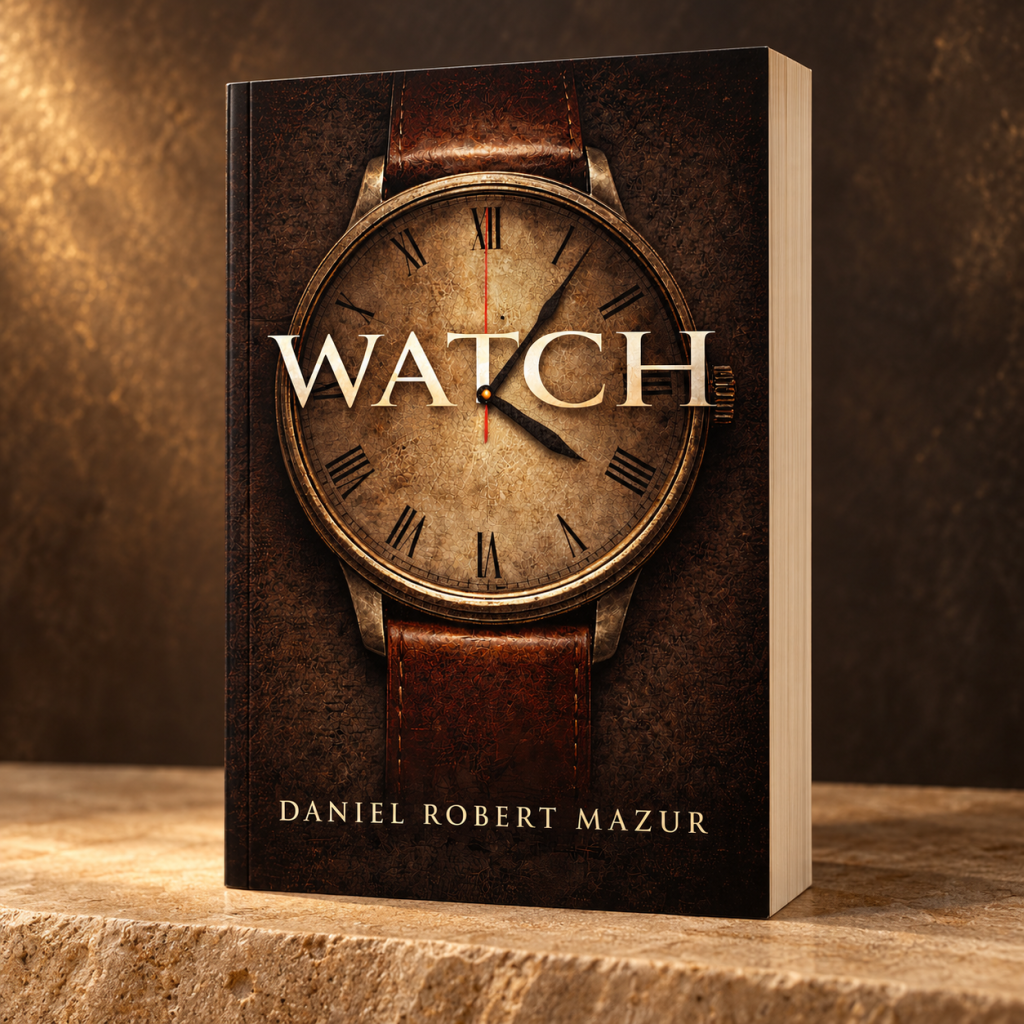
Understanding the Back Cover of Watch
A guide for readers before the opening pages
Below the cover image, you will find the first ten pages of Watch.
These opening pages introduce the voice, atmosphere, and emotional world of the novel. They are not meant to explain everything at once. Much of Watch is about discovering, slowly, that things remembered as ordinary may have carried meanings that could not be seen at the time.
Before reading them, this guide offers some context for the questions raised on the back cover and for the kind of story that follows.
The question at the heart of the novel
The back cover of Watch opens with a question:
What if the life you believed was yours had been quietly arranged long before you knew how to question it?
That question reaches beyond whether someone has been lied to or manipulated.
It asks something more difficult.
How much of a life can be shaped before a person is old enough, secure enough, or aware enough to recognize that shaping?
We make choices. But we do not begin making them from nowhere. Family, circumstance, authority, kindness, fear, loyalty, need, and belonging have already begun teaching us what choices seem possible.
Watch begins inside that uncertainty.
What “quietly arranged” means
The shaping in Watch rarely announces itself as control.
It can arrive as help.
A meal when someone is hungry. A place to belong. Work that gives the day purpose. Someone remembering your name. Someone noticing whether you come home.
None of those things are false simply because something else may exist beside them.
That distinction matters.
The novel does not ask the reader to discover that every kindness was secretly cruel. It asks whether genuine care and influence can exist at the same time, and what happens when the person receiving that care cannot yet see where one ends and the other begins.
Belonging has rules
The young man at the center of Watch enters a world that gives him things he has been missing.
Food. Purpose. Stability. Recognition.
He is no longer invisible.
But belonging gradually teaches him its own language. Certain qualities are rewarded. Certain questions carry consequences. Silence can look like maturity. Restraint can look like strength. Loyalty can become more important than understanding.
No one needs to explain all of this directly.
A person can learn the rules of a room simply by noticing what happens to those who break them.
When silence resembles trust
Silence runs throughout Watch, but it does not always mean the same thing.
Sometimes silence protects.
Sometimes it gives another person room.
Sometimes it comes from fear.
Sometimes it keeps a system intact.
And sometimes two people can experience the very same silence differently.
This is one of the central tensions of the novel. The protagonist learns early that withholding words can be a form of strength. Later, he must confront what happens when that same ability allows one person to decide what another is permitted to know.
When the record changes the memory
The back cover says:
Then records begin to surface.
That is important because Watch is not simply a story about discovering hidden facts.
The discoveries alter memories.
Encounters that once appeared accidental begin to look different. Conversations take on another meaning. People who seemed to enter his life by chance may not have arrived entirely by chance.
But each answer complicates the story rather than simplifying it.
Knowing that something was arranged does not necessarily reveal who understood the arrangement, who believed they were helping, who was being used, or how far responsibility extends.
The more clearly the protagonist sees the structure around his life, the harder it becomes to divide everyone into innocent and guilty.
The people who shape us were shaped too
This became especially important in the final version of Watch.
The novel does not stop with the discovery that powerful people influenced other lives.
It keeps asking where their beliefs came from.
Someone may exercise authority while believing he is protecting people. Someone may preserve a system because he inherited its assumptions before he ever had reason to question them. Someone may cause harm while also doing genuine good.
Understanding this does not erase responsibility.
But it complicates judgment.
The person who shaped your life may also have been living inside a design he never completely understood.
That is one reason Watch resists simple villains.
Walking away is not the same as becoming free
A person can leave a place without leaving behind everything learned there.
Habits remain.
Ways of reading people remain.
Instincts about when to speak and when to remain silent remain.
Even the abilities developed inside a controlling environment can still be useful. Patience. Observation. Restraint. Loyalty. The ability to recognize what others miss.
The question becomes not simply whether those qualities were given freely.
It becomes:
What will you do with them now?
The finished novel does not treat awareness as a clean escape. Recognition does not erase what came before. It only makes possible a different kind of choice.
The uncomfortable turn
There is another question beneath the back-cover description that becomes increasingly important as the novel develops.
What happens when someone who has been denied the truth begins deciding how much truth other people should receive?
That is where Watch becomes more than a story about a young man discovering what others did to him.
He begins making decisions himself.
What should be revealed?
What should remain hidden?
When does protecting someone become deciding for them?
When does waiting become wisdom?
When does it become control?
The novel does not exempt its protagonist from the questions he asks of everyone else.
Care and control
The boundary between care and control is deliberately difficult to locate in Watch.
Care can be real.
So can the harm beside it.
A person can feed someone, protect someone, remember his name, and still participate in a structure that limits what he is allowed to know.
The novel does not ask the reader to choose which of those facts is the “real” one.
Both can be true.
That is what makes the moral problem difficult.
Why the story moves quietly
Watch is intentionally restrained.
The most important changes often occur through small gestures, pauses, omissions, records, conversations, and things noticed only after they have happened.
That style reflects the subject of the book.
A life is rarely shaped by one dramatic moment alone. It is shaped repeatedly, through what becomes ordinary.
A meal.
A rule.
A favor.
A warning.
A silence.
A person waiting at the same table.
Eventually those ordinary things form a structure.
What the title means
The word Watch begins as an instruction.
Look.
Pay attention.
Do not turn away.
But as the novel continues, the meaning widens.
To watch can mean to observe.
To guard.
To wait.
To judge.
To keep track of someone.
To notice what others miss.
And eventually, to recognize the forces that have been watching and shaping you.
The opening pages begin that process long before the protagonist understands where it will lead.
No simple answer
Watch is not arguing that freedom means becoming untouched by other people.
No one is untouched.
Families shape us. Communities shape us. Love shapes us. Fear shapes us. Circumstance shapes us. Even resistance can be shaped by the thing being resisted.
The deeper question is what becomes possible once those influences can finally be seen.
Knowing where a belief came from does not automatically tell us whether to keep it.
Knowing how a life was made does not tell us what to do with it.
What the first ten pages are meant to do
The pages that follow are the opening of the novel.
They do not explain the mystery or tell you who should be trusted.
Instead, they introduce the conditions from which everything else grows.
A boy who wants to belong.
A man whose kindness is real.
A world in which silence has value.
And the first suggestion that being seen and being free may not always be the same thing.
The larger question of Watch
Watch is ultimately concerned with choice, but not with the simple idea that people either possess freedom or do not.
It asks what choice means after we recognize everything that participated in teaching us how to choose.
What did we inherit?
What did we accept?
What was decided before we understood enough to object?
What parts of it have become part of us?